 Blogs

 Oct 24, 2026
 10 mins read
There is no established best time of day to take vitamin C. The two most widely used reference sources on the nutrient, the NIH Office of Dietary Supplements and the Philippine Dietary Reference Intakes, set a daily amount and a daily ceiling, and neither sets an hour. What the published figures do show is that the body absorbs a smaller share of a large amount than of a small one, which makes how much you take in one sitting the part worth paying attention to. The practical answer for most people is a time you will not forget, and an amount your stomach tolerates.
If you take a vitamin C product, its label is your instruction. Bewell's vitamin C capsules, for example, are labelled to be taken "with beverage or meal". Many people make it part of their morning, with a glass of water or with breakfast, because a morning habit is easy to keep, and both fit that label. If vitamin C upsets your stomach or gives you acid reflux, taking it with food or right after a meal may help.
When to Take Vitamin C, on the Published Evidence
What is the best time to take vitamin C? What the published evidence says: No reference body has set one, and there is no single best time of day. Mornings, with water or with breakfast, are an easy time to remember. Follow your product's label: Bewell's vitamin C capsules are labelled to be taken "with beverage or meal". Source: NIH ODS · Bewell-C and Bewell-C Zinc Protect pack labels.
How much of it does the body take in? What the published evidence says: "Approximately 70% to 90% of vitamin C is absorbed at moderate intakes of 30 to 180 milligrams (mg)/day." Source: NIH ODS.
What happens at larger amounts? What the published evidence says: "Absorption of vitamin C decreases to less than 50% when taking amounts greater than 1000 mg." Source: Harvard T.H. Chan.
Does a supplement behave differently from food? What the published evidence says: No. "The ascorbic acid used in supplements has a bioavailability that is equivalent to that of the ascorbic acid that occurs naturally in foods." Source: NIH ODS.
Why does a large amount upset some stomachs? What the published evidence says: The complaints come "due to the osmotic effect of unabsorbed vitamin C in the gastrointestinal tract". Source: NIH ODS.
What is the daily ceiling in the Philippines? What the published evidence says: 1,000 mg a day for adults. Source: FNRI PDRI 2015.
What is the international ceiling? What the published evidence says: "The Tolerable Upper Intake Level for vitamin C ranges from 400 to 2,000 mg, depending on age." For adults 19 and over it is 2,000 mg. Source: NIH ODS.
Does the ceiling apply to everyone? What the published evidence says: No. "The ULs do not apply to individuals who are receiving vitamin C for medical treatment, but such individuals should be under the care of a physician." Source: NIH ODS.
Is There a Best Time of Day to Take Vitamin C?
It is one of the most searched questions about the nutrient in the Philippines, and the honest answer is that no reference body has set one.
The United States National Institutes of Health Office of Dietary Supplements publishes the most widely cited technical sheet on vitamin C. It covers how much the body absorbs, what the reference intakes are, what the upper limit is, who is more likely to fall short, and what happens at high intakes. It does not name a time of day. Neither do the Philippine Dietary Reference Intakes 2015 from the Food and Nutrition Research Institute, which set the daily figures used in Philippine practice.
That silence is not an oversight. The question these documents answer is how much a person needs across a day, not which hour they take it in. When a reference body has no position, the careful thing to report is that it has no position.
What the same documents do address, in detail, is amount. That is where the useful answer lives.
Why Does the Amount Matter More Than the Hour?
The body does not take in vitamin C at a fixed rate. The share absorbed falls as the amount in a single sitting rises.
"Approximately 70% to 90% of vitamin C is absorbed at moderate intakes of 30 to 180 milligrams (mg)/day."
National Institutes of Health, Office of Dietary Supplements
Above that range the share drops. The Harvard T.H. Chan School of Public Health puts the turn plainly:
"The intestines have a limited ability to absorb vitamin C. Studies have shown that absorption of vitamin C decreases to less than 50% when taking amounts greater than 1000 mg."
So a single large amount does not deliver proportionally more than a smaller one. Past a point, a rising share simply leaves the body again. The NIH describes what happens to it: at higher intakes, "absorbed, unmetabolized ascorbic acid is excreted in the urine".
This is the reason the practical question is not when, but how much at once. If you take a large amount in one go, a meaningful part of it is not retained no matter what hour the clock says.
Should You Take Vitamin C on an Empty Stomach or With Food?
Here the reference sources are quiet again, and it is worth saying so rather than filling the gap.
The NIH sheet does not give an instruction about taking vitamin C with or without a meal. What it does establish is that the form in a supplement behaves like the form in food:
"The ascorbic acid used in supplements has a bioavailability that is equivalent to that of the ascorbic acid that occurs naturally in foods."
National Institutes of Health, Office of Dietary Supplements
The reason people ask about food is usually comfort rather than absorption. Some people find that vitamin C taken on an empty stomach is uncomfortable. The NIH explains where that discomfort comes from:
"The most common complaints are diarrhea, nausea, abdominal cramps, and other gastrointestinal disturbances due to the osmotic effect of unabsorbed vitamin C in the gastrointestinal tract."
The mechanism matters because it points at the fix. The discomfort is tied to vitamin C that was not absorbed sitting in the gut. That is a function of how much arrived at once. If a particular amount is uncomfortable for you, the two things worth adjusting are the amount in one sitting and whether you take it alongside food.
The acidity of the form you are taking is a separate question from the amount, and it is worked through in sodium ascorbate vs ascorbic acid.
Read the pack you own. Any instruction printed on your own product's label is specific to that product and overrides a general article, this one included. If the label tells you how to take it, follow the label. Bewell-C and Bewell-C Zinc Protect, for example, are both labelled to be taken "with beverage or meal".
Taking vitamin C with food may also help if it upsets your stomach or gives you acid reflux. Philippine health site Hello Doctor gives the same advice: if vitamin C upsets your stomach, take it with your meals. A meal has a side benefit too, because vitamin C helps the body absorb the iron in plant foods (NIH Office of Dietary Supplements).
People with hyperacidity or a history of stomach ulcers may find vitamin C irritating, particularly in acidic forms, and should ask a healthcare professional about the right form and amount.
If acidic vitamin C bothers your stomach, ask your pharmacist about a non-acidic form such as sodium ascorbate. Bewell-C is a non-acidic sodium ascorbate capsule.
Morning or Night: Does It Change Anything?
No reference source distinguishes between them, so there is no evidence-based reason to prefer one.
What does differ is whether you will actually take it. Vitamin C is water soluble, the body does not hold a large reserve of it, and the reference intakes are daily figures. A daily figure is met by taking it on most days, which makes consistency the variable you can genuinely control.
So the useful rule is the dull one: pick the time you are least likely to skip. For most people that is attached to an existing habit, such as a meal you never miss. The hour itself is not doing the work. Pairing it with a meal also fits any label that says to take it with a beverage or meal.
For many people, the easiest slot is the morning. Philippine health site Hello Doctor suggests a simple morning routine: take vitamin C with a glass of water before you eat breakfast. That routine also fits a "with beverage or meal" label, since water counts as a beverage. If vitamin C before food bothers your stomach, move it to breakfast instead.
Is It Better to Split It Through the Day or Take It All at Once?
This follows directly from the absorption figures rather than from any timing rule.
Since the share absorbed falls as the amount in one sitting rises, splitting a larger daily amount into two smaller ones means each sitting falls in the range where a higher share is taken in. The arithmetic is the same arithmetic as above, applied twice.
Two caveats keep this honest. First, this is a statement about the share absorbed, not a claim that splitting produces any health outcome. Second, for people whose daily amount already sits in the 30 to 180 mg range the NIH describes, there is nothing to split. The question only arises once the daily figure is well above that.
If your product is labelled for more than one unit a day, the label has usually already answered this. Follow it.
Bewell-C, for example, is labelled to be taken at 1 to 3 capsules a day with a beverage or meal. If you take more than one, a capsule with breakfast and another with a later meal fits both the label and the absorption figures above.
How Much Is Too Much in a Day?
Two ceilings are quoted in the Philippines, and they are both real.
The PDRI 2015 tables set the Philippine upper intake level for adults at 1,000 mg a day. The NIH sets its equivalent higher:
"The Tolerable Upper Intake Level for vitamin C ranges from 400 to 2,000 mg, depending on age."
National Institutes of Health, Office of Dietary Supplements
For adults aged 19 and over, the NIH figure is 2,000 mg. Neither number is a mistake. They are set by different bodies working from different frameworks, and both are cited in Philippine practice. Which one applies to you, and how either relates to the number printed on a pack, is worked through in how much vitamin C Filipino adults actually need per day.
One qualification on both figures comes from the NIH itself:
"The ULs do not apply to individuals who are receiving vitamin C for medical treatment, but such individuals should be under the care of a physician."
That is the line that settles most arguments about ceilings. A person taking vitamin C under a doctor's direction is in a different situation from a person choosing an amount off a shelf, and the ceiling was written for the second.
What happens above the ceiling is the gut symptoms quoted earlier rather than anything dramatic. The detail belongs in its own piece, and this article does not try to be that piece.
What If You Take It Alongside Other Supplements?
A combination product carries more than one nutrient, and each nutrient has its own reference intake and its own ceiling. A figure that is comfortably inside the range for vitamin C tells you nothing about the zinc, calcium or iron sitting beside it in the same capsule.
Two practical consequences follow:
Add up what you are actually taking. If more than one product on your shelf contains the same nutrient, the relevant number is the total across all of them, not the number on any single pack.
Check the combination with a pharmacist or your doctor, not with an article. Interactions between nutrients are specific to the products and the amounts involved.
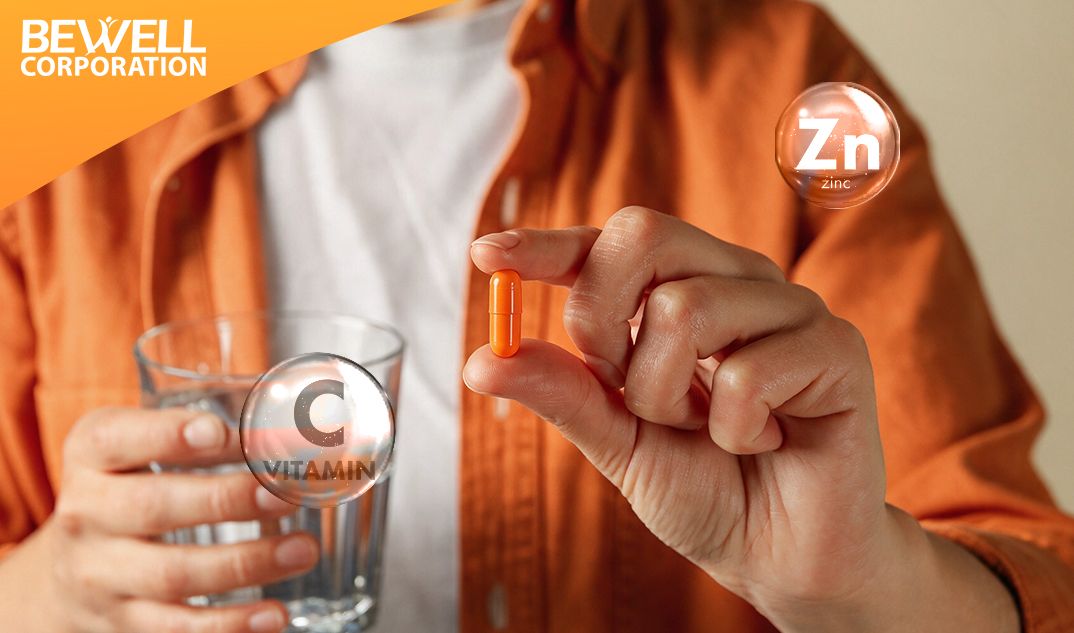
If you take vitamin C and zinc, Bewell-C Zinc Protect has both in one capsule: one label to follow and one amount to count.
The vitamin C and zinc pairing in particular is covered in vitamin C and zinc, including what to check on a label when both appear on it.
What to Do With This in Practice
There is no established best hour. Pick the one you will keep.
How much you take in one sitting matters more than when you take it.
If a given amount is uncomfortable, adjust the amount or take it with food.
Your own pack's instruction beats any general article.
Count the total across every product you take, not pack by pack.
Anything involving a medical condition, a pregnancy, a child, or a prescription belongs with your doctor or pharmacist.
About Bewell Nutraceuticals Corporation
Bewell Nutraceuticals Corporation is a Philippine FDA-licensed Trader and Distributor of both Drug and Food, operating from Quezon City since 2007. Bewell manages the formulation and the sourcing of raw materials for its products, which are manufactured by a partner and sold through Mercury Drug, Watsons, South Star Drug, Rose Pharmacy and other drugstores nationwide.
Frequently Asked Questions
What is the best time to take vitamin C?
A time you will keep to every day, taken the way your product's label directs. Bewell's vitamin C capsules, for example, are labelled to be taken "with beverage or meal". The NIH Office of Dietary Supplements and the Philippine Dietary Reference Intakes both set a daily amount and a daily ceiling, and neither specifies an hour. Because the reference figures are daily ones and the body holds no large reserve of vitamin C, the variable that actually matters is taking it consistently. For many people that means the morning, with a glass of water or with breakfast, and both fit a "with beverage or meal" label.
Is it better to take vitamin C in the morning or at night?
Neither reference source distinguishes between the two, so there is no evidence-based reason to prefer one over the other. The choice that makes a measurable difference is whether you take it at all on a given day, not which half of the day you take it in. Many people find the morning easiest to remember.
Can you take vitamin C on an empty stomach?
Follow your pack first: if it says to take it with a beverage or meal, as Bewell-C's does, take it that way. People with hyperacidity or a history of stomach ulcers may find vitamin C irritating on an empty stomach, particularly in acidic forms, and should ask a healthcare professional about the right form and amount. If acidic vitamin C bothers you, ask your pharmacist about a non-acidic form such as sodium ascorbate. Bewell-C is a non-acidic sodium ascorbate capsule. Beyond that, the reference sources give no instruction either way. Some people find a larger amount uncomfortable without food. The NIH attributes those complaints to "the osmotic effect of unabsorbed vitamin C in the gastrointestinal tract", which means the trigger is the amount that was not absorbed rather than the absence of a meal. If it is uncomfortable for you, the two things to adjust are the amount in one sitting and whether you take it with food.
Does the body absorb all the vitamin C you take?
No, and the share falls as the amount rises. The NIH states that "approximately 70% to 90% of vitamin C is absorbed at moderate intakes of 30 to 180 milligrams (mg)/day". Harvard T.H. Chan School of Public Health states that absorption "decreases to less than 50% when taking amounts greater than 1000 mg". The portion that is absorbed but not used is excreted in the urine.
How much vitamin C is too much in one day?
The Philippine Dietary Reference Intakes 2015 set the upper intake level for adults at 1,000 mg a day. The NIH sets its Tolerable Upper Intake Level at 2,000 mg for adults aged 19 and over. Both are cited in Philippine practice and they come from different frameworks. The NIH adds that the ULs "do not apply to individuals who are receiving vitamin C for medical treatment, but such individuals should be under the care of a physician".
Is a vitamin C supplement absorbed differently from vitamin C in food?
No. The NIH states that "the ascorbic acid used in supplements has a bioavailability that is equivalent to that of the ascorbic acid that occurs naturally in foods".
Should you split vitamin C through the day?
It follows from the absorption figures rather than from any timing rule. Because the share absorbed falls as the amount in one sitting rises, splitting a large daily amount means each sitting falls where a higher share is taken in. This is a statement about absorption, not a health outcome, and it only arises once a daily figure sits well above the 30 to 180 mg range. If your pack is labelled for more than one unit a day, follow the pack.
Related Bewell Products
Bewell-C Non-Acidic Vitamin C: Ascorbic acid (as sodium ascorbate), the non-acidic form of vitamin C, in a capsule. Label directions: "Take 1-3 capsules a day with beverage or meal or as prescribed by physician."
Bewell-C Zinc Protect: Non-acidic vitamin C together with zinc, in a single capsule. Label directions: "Take 1-2 capsules a day with beverage or meal or as prescribed by physician."
Bewell-C Kids: Non-acidic vitamin C with zinc, in a syrup formulated for children.
Bewell-C products are available at Mercury Drug, Watsons, South Star Drug, Rose Pharmacy and other drugstores nationwide.
Always follow the instruction printed on your own pack, and ask your pharmacist or doctor if you are unsure.
Related Articles
Sources
[1] National Institutes of Health, Office of Dietary Supplements. Vitamin C: Fact Sheet for Health Professionals (read 6 October 2026). Absorption figures, bioavailability of supplemental ascorbic acid, gastrointestinal effects, Tolerable Upper Intake Levels and the medical-treatment exemption.
[2] Harvard T.H. Chan School of Public Health, The Nutrition Source. Vitamin C (read 6 October 2026). The fall in absorption above 1,000 mg, and the 2,000 mg upper intake level.
[3] Food and Nutrition Research Institute, Department of Science and Technology. Philippine Dietary Reference Intakes 2015. Philippine reference intakes and the 1,000 mg adult upper intake level.
[4] Hello Doctor. The Best Time To Drink Vitamin C: Is It In The Morning? (updated 13 February 2022). The morning routine of vitamin C with a glass of water, and taking it with meals if it upsets your stomach.