 Blogs
Blogs 
 Sep 28, 2026
  13 mins read
Vitamin C and zinc are two separate nutrients with separate jobs, sold in one capsule for convenience rather than because one helps you absorb the other. Each does real work on its own: the NIH describes zinc as required for the catalytic activity of hundreds of enzymes, and vitamin C as required for making collagen. The most useful thing to know before you buy is that the zinc figure on a label is the zinc itself, not the weight of the compound it comes in, so 50 mg of zinc gluconate carries only about 7 mg of zinc. Filipino adults need 6.5 mg of zinc a day for men and 4.6 mg for women.
Why Vitamin C and Zinc Are Sold Together
Walk into any Philippine pharmacy and a large share of the vitamin C on the shelf now has zinc in it too. The pairing is so common that it is easy to assume the two work on each other somehow. They do not, in the way most people mean. They are two separate nutrients with separate jobs, put in one capsule so that a person taking both does not have to buy and remember two products.
Vitamin C is a vitamin that dissolves in water. The body cannot make it or store much of it, so it has to come from food regularly. Zinc is a mineral the body needs in much smaller amounts, and it takes part in many everyday processes in your cells.
The amounts say it plainly. Filipino adults need vitamin C in tens of milligrams a day, and zinc in single digits.
What Do Vitamin C and Zinc Actually Do?
Since they do not work on each other, the useful question is what each one does on its own. Both answers come from the National Institutes of Health Office of Dietary Supplements, which publishes a reference fact sheet on each nutrient.
Zinc. The NIH states that zinc "is involved in many aspects of cellular metabolism", and that it "is required for the catalytic activity of hundreds of enzymes, and it plays a role in enhancing immune function, protein and DNA synthesis, wound healing, and cell signaling and division".
Vitamin C. The matching fact sheet states that vitamin C "is required for the biosynthesis of collagen, L-carnitine, and certain neurotransmitters" and is "also involved in protein metabolism". On collagen it adds that it "is an essential component of connective tissue, which plays a vital role in wound healing". It describes vitamin C as "an important physiological antioxidant" that "has been shown to regenerate other antioxidants within the body, including alpha-tocopherol (vitamin E)", and states that vitamin C "plays an important role in immune function".
Two things are worth noticing in those descriptions. Both nutrients are named in connection with wound healing, by different routes. And both are named in connection with immune function. That is a shared role rather than one nutrient helping the other, which is a different claim from the one usually printed on the front of a box.
These are descriptions of what the nutrients do in a body that has enough of them. They are not a promise about what any product will do for you, and they are not a reason to take more than the amounts set out below.
How Much Vitamin C and Zinc Do Filipino Adults Need?
The Philippine standard is the Philippine Dietary Reference Intakes 2015, published by the Food and Nutrition Research Institute under the Department of Science and Technology. It sets a Recommended Nutrient Intake for each nutrient, which is the daily amount that covers nearly everyone in a given age and sex group.
For adults aged 19 and over it gives zinc as 6.5 mg a day for men and 4.6 mg a day for women. Pregnancy adds 5.1 mg and breastfeeding adds 6.7 mg. For vitamin C over the same ages the figures are 70 mg for men and 60 mg for women.
Those zinc numbers surprise people who are used to seeing 20, 25 or 50 mg printed on a bottle. The reference figure is not a target to beat. It is the amount that covers nearly everyone in that group who is in good health, and it sits well below what many combination products supply.
The American figures are higher. The National Institutes of Health Office of Dietary Supplements gives 11 mg of zinc a day for adult men and 8 mg for adult women. Each country sets its own figures by looking at its own population and diet, so a gap between two countries is normal rather than a contradiction. Both can be cited side by side.
Why 50mg of Zinc on the Box Is Not 50mg of Zinc
This is the most useful thing to understand about a combination label, and it is where most shelf comparisons quietly go wrong.
Zinc does not go into a capsule as pure metal. It goes in as a compound: zinc sulfate, zinc gluconate, zinc citrate or zinc oxide. Only part of the weight of that compound is zinc. The rest is whatever the zinc is attached to.
The NIH states the rule directly:
“The Supplement Facts panel on a dietary supplement label declares the amount of elemental zinc in the product, not the weight of the entire zinc-containing compound.”
Elemental zinc means the zinc itself, and that is the figure a properly written label gives you. Take an example. Zinc gluconate is about 14.35 percent zinc by weight, worked out from its chemical formula. So 50 mg of zinc gluconate carries roughly 7 mg of zinc, not 50 mg. Zinc oxide is about 80.34 percent zinc, so the same 50 mg would carry about 40 mg, nearly six times more.
A good label states both, in the form "10 mg zinc, equivalent to X mg of" whichever compound is used. If you see a figure with no sign of which one it means, that is the question to ask before you compare it against anything else.
Vitamin C labels work the same way when the vitamin comes as a salt such as sodium ascorbate. That is explained in Sodium Ascorbate vs Ascorbic Acid: What Actually Differs.
Does Vitamin C Help Your Body Absorb Zinc?
There is no good evidence that it does. That is a narrow point about one marketing line, not a reason to avoid taking the two together.
The NIH fact sheet on zinc is the reference document here, and it covers absorption thoroughly. It goes through what raises and lowers the amount of zinc the body takes up, the different compounds used in supplements, and a whole section on what zinc interacts with. In that entire document, vitamin C appears once, inside a description of an eye-health formula that also contained copper, vitamin E and beta-carotene. It never appears in the absorption discussion.
There is a real version of this idea, and it involves a different mineral. The NIH states that vitamin C "improves the absorption of nonheme iron", the form of iron present in plant-based foods. So vitamin C does help the body absorb one mineral. It is iron, not zinc.
So what does that mean for you? Nothing is wrong with taking the two together, and neither nutrient does less because the other is there. It means the pairing is a convenience rather than a proven absorption advantage. A claim that one improves the uptake of the other would need a human study behind it.
This changes how you read the shelf. If two products are alike except that one advertises a synergy between the two nutrients, that advertised synergy is the difference between them, and it is a claim rather than a measured advantage.
What Really Affects How Much Zinc You Absorb
Several things genuinely do, and all of them are better documented than the vitamin C question.
Phytate in plant foods. Phytate is a natural compound found in whole grains, legumes, nuts and seeds. The NIH describes what it does plainly: "Phytates, the storage form of phosphorus in plants, bind some minerals such as zinc in the intestine and form an insoluble complex that inhibits zinc absorption." The effect is big enough to matter across a whole diet. The NIH puts the range at "5% to more than 50%, depending on the amount of plant-based foods (and thus of phytate) in the diet".
That matters more here than the numbers suggest, because rice and legumes are staples in the Philippines rather than occasional foods. It is not a reason to avoid them. It is why the same zinc figure on paper can mean different things in two different diets.
Iron taken at the same time. This one matters for combination products, because vitamin C, zinc and iron are often sold in a single formula. The NIH is specific: "Taking supplements containing 25 mg elemental iron or more at the same time as zinc supplements can reduce zinc absorption and plasma zinc concentrations." Iron added to fortified food does not do the same thing, because the form used there barely dissolves in the gut. So the concern is a supplement at that level, not iron in your food.
Notice the direction of travel across those two facts. Vitamin C helps you absorb iron, and iron at that level works against zinc. In a product carrying all three, both of those are true at once, which is worth knowing before you compare it against a product carrying two.
Because of that interaction, Mayo Clinic recommends taking zinc and iron supplements at least two hours apart, so the body gets the full benefit of each. That applies to supplements at that level, not to the iron in ordinary food.
Which zinc compound is used. There are real differences here, though smaller than the marketing around them suggests. The NIH reports that absorption "from supplements that contain zinc citrate or zinc gluconate is similar, at approximately 61% in young adults; the absorption from supplements that contain zinc oxide is 50%".
On timing, consistency matters more than the hour of the day. For vitamin C, timing is covered in Vitamin C 500mg or 1000mg: How Much Filipino Adults Actually Need Per Day.
How Much Zinc Is Too Much?
The ceiling for zinc sits closer to ordinary supplement amounts than most people expect.
The PDRI 2015 puts the Philippine upper limit at 45 mg a day for adults, and 40 mg a day during pregnancy and breastfeeding from age 19. That is a ceiling for your total intake in a day, not a target. The PDRI notes that its zinc limit is adapted from World Health Organization and FAO guidelines rather than set on its own.
The American limit is slightly lower. The NIH puts it this way: "The Tolerable Upper Intake Level for zinc is 40 mg for adults, and it ranges from 4 to 34 mg for infants, children, and adolescents, depending on age."
That is the reverse of the vitamin C position, where the Philippine limit of 1,000 mg a day sits below the American figure of 2,000 mg. There is nothing contradictory in it. Different bodies, different evidence reviews.
What the zinc limit is based on is the interesting part. The NIH explains that the American figures were "established... based on the levels of zinc that have an adverse effect on copper status". Zinc and copper compete in the body, and a sustained high zinc intake can push copper down. The NIH puts that threshold at 50 mg of zinc a day or more taken over a period of weeks, and states that at that level it can interfere with copper absorption and lower HDL cholesterol levels.
Two things follow. This is about elemental zinc, so it is the same figure the label rule above applies to. And food is not the concern: the NIH notes that "the amount of zinc obtained from food is rarely as high as 50 mg". Someone reaching that level is almost always doing it through supplements, usually by taking more than one product with zinc in it without adding them up.
Which Filipino Foods Are Rich in Vitamin C and Zinc?
Supplements are meant to add to a diet rather than replace part of it, so it helps to know where both nutrients come from at the table.
For zinc, the NIH is direct about the ranking: "Meat, fish and other seafood, eggs, and dairy products are good sources of zinc. Oysters contain particularly high amounts of zinc. Beans, nuts, and whole grains also contain zinc, but the bioavailability of zinc from these foods is lower than that of animal foods." It also notes that "fruits and vegetables contain very little zinc". Bioavailability there means how much of it your body can actually take up.
Vitamin C runs the opposite way. It sits in fruits and vegetables and is largely absent from meat and fish. Guava, calamansi, papaya, mango, kangkong, malunggay and bell pepper are all everyday Philippine sources.
That contrast is the honest reason the two get discussed together. It is not that one helps the other be absorbed. It is that no single kind of food supplies both well, so a diet short on one is not necessarily short on the other.
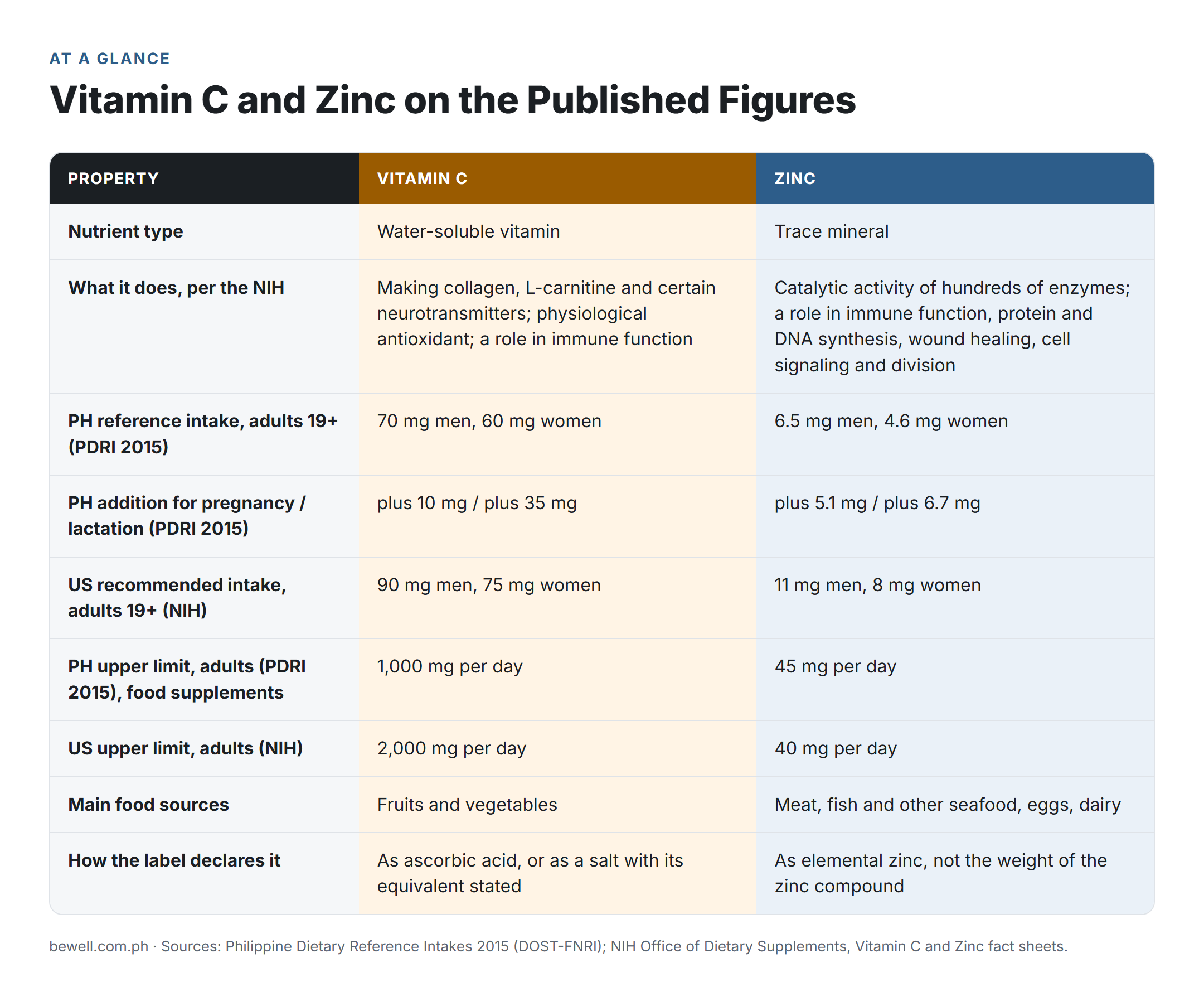
Vitamin C and Zinc on the Published Figures
Nutrient type
Vitamin C: Water-soluble vitamin
Zinc: Trace mineral
What it does, per the NIH
Vitamin C: Making collagen, L-carnitine and certain neurotransmitters; physiological antioxidant; a role in immune function
Zinc: Catalytic activity of hundreds of enzymes; a role in immune function, protein and DNA synthesis, wound healing, cell signaling and division
PH reference intake, adults 19+ (PDRI 2015)
Vitamin C: 70 mg men, 60 mg women
Zinc: 6.5 mg men, 4.6 mg women
PH addition for pregnancy / lactation (PDRI 2015)
Vitamin C: plus 10 mg / plus 35 mg
Zinc: plus 5.1 mg / plus 6.7 mg
US recommended intake, adults 19+ (NIH)
Vitamin C: 90 mg men, 75 mg women
Zinc: 11 mg men, 8 mg women
PH upper limit, adults (PDRI 2015), food supplements
Vitamin C: 1,000 mg per day
Zinc: 45 mg per day
US upper limit, adults (NIH)
Vitamin C: 2,000 mg per day
Zinc: 40 mg per day
Main food sources
Vitamin C: Fruits and vegetables
Zinc: Meat, fish and other seafood, eggs, dairy
How the label declares it
Vitamin C: As ascorbic acid, or as a salt with its equivalent stated
Zinc: As elemental zinc, not the weight of the zinc compound
How to Check the Label Before You Buy
These checks work on any brand, and none of them ask you to take a claim on trust.
For vitamin C on its own, use the seven-point checklist in How to Choose the Best Vitamin C in the Philippines: A 2026 Buyer's Guide.
Find the elemental zinc figure. If the label gives a compound weight without saying how much actual zinc that comes to, you cannot compare it with anything. A label that states both is telling you more, not less.
Add up everything you already take. The upper limit applies to your total for the day, from every source. A multivitamin, a separate zinc product and a combination vitamin C can overlap without anyone meaning them to. This is the most common way people quietly pass 40 or 45 mg.
Check whether there is iron in it. If the formula carries 25 mg or more of elemental iron alongside zinc, the interaction above applies to that product.
Read the suggested daily intake, then do the arithmetic. The figure on the front of a pack is usually per capsule. What counts is that figure multiplied by the number of capsules the label suggests per day.
Check the registration number. Every health product legally sold in the Philippines carries a registration number from the Philippine FDA, printed on the pack. If there is no number, treat that as a reason not to buy, and if you are unsure about a product, ask the pharmacist at the counter.
Treat a synergy claim as a claim. Given what the evidence does and does not show, a product advertising that one nutrient helps the other is asserting something beyond the published position. That is worth noticing, whatever else you think of the product.
Bewell-C Zinc Protect, for example, pairs non-acidic vitamin C with zinc in a single capsule, and the same label checks apply to it.
Important Information
This article is general consumer information about vitamin C and zinc. It is not medical advice, and it is not a diagnosis or a treatment recommendation. Vitamin C and zinc are nutrients, and nothing here should be read as a claim that any product prevents, treats, or cures any illness or condition.
Reference intake figures are taken from the Philippine Dietary Reference Intakes 2015 published by DOST-FNRI and from the National Institutes of Health Office of Dietary Supplements, and both are cited in full in the sources below. Consult a doctor or a licensed pharmacist about your own supplement use, particularly if you are pregnant, breastfeeding, buying for a child, managing a health condition, or taking regular medication.
Always follow the directions printed on the product you buy.
About Bewell Nutraceuticals Corporation
Bewell Nutraceuticals Corporation is a Philippine FDA-licensed Trader and Distributor of both Drug and Food, operating from Quezon City since 2007. Bewell manages the formulation and the sourcing of raw materials for its products, which are manufactured by a partner and sold through Mercury Drug, Watsons, South Star Drug, Rose Pharmacy and other drugstores nationwide. The company supplies Bewell-C, a sodium ascorbate vitamin C at 500 mg per capsule, registered with the Philippine FDA as a non-prescription drug under registration number DRHR-1355, and labelled at one to three capsules daily. Bewell-C reaches Filipino buyers through Mercury Drug, Watsons, South Star Drug, Rose Pharmacy, Rojon, and small chain drugstores, plus official stores on Shopee, Lazada, and TikTok Shop. To see the full Bewell-C range and where to buy it, visit bewell.com.ph.
Frequently Asked Questions
Can you take vitamin C and zinc together every day?
They are commonly formulated in a single capsule and there is no interaction between the two that would argue against it. The thing to watch is not the pairing but the total amount of zinc from every product you take in a day, since the Philippine upper limit is 45 mg and the American figure is 40 mg. Follow the suggested daily intake on the label, and speak to a physician or pharmacist about your own situation.
What are the benefits of vitamin C and zinc?
Both are worth getting for what each one does on its own. The NIH states that zinc is required for the catalytic activity of hundreds of enzymes and plays a role in enhancing immune function, protein and DNA synthesis, wound healing, and cell signaling and division. It states that vitamin C is required for making collagen, is an important physiological antioxidant, and plays an important role in immune function. So both are named by the NIH in connection with immune function, each by its own separate route. What the evidence does not show is that either one improves your absorption of the other.
Do vitamin C and zinc support the immune system?
Both are named by the NIH in connection with immune function. The NIH states that zinc plays a role in enhancing immune function, protein and DNA synthesis, wound healing, and cell signaling and division. It states that vitamin C plays an important role in immune function and is an important physiological antioxidant. That is a shared role each nutrient has on its own, not one nutrient boosting the other. These describe what the nutrients do in a body that has enough of them, and are not a promise about what any product will do for you.
Does vitamin C help the body absorb zinc?
There is no good evidence that it does, and that is a narrow point about one marketing claim rather than a reason to avoid taking the two together. The NIH Office of Dietary Supplements fact sheet on zinc covers absorption in detail and does not list vitamin C among the things that affect it. What the published evidence does identify is phytate in plant foods, supplemental iron at 25 mg or more taken at the same time, and the particular zinc compound used. Both nutrients are worth getting, so the pairing is a convenience rather than a demonstrated absorption advantage.
Why does one product say 50 mg of zinc and another says 10 mg?
Often because they are measuring different things. The figure that matters is elemental zinc, and the NIH states that a Supplement Facts panel declares elemental zinc rather than the weight of the whole zinc compound. Zinc gluconate is only about 14 percent zinc by weight, so 50 mg of the compound is roughly 7 mg of zinc. If a label gives a number without saying which of the two it is, that is the question to ask before comparing it with another product.
What are the side effects of taking too much zinc?
The NIH describes them as nausea, dizziness, headaches, gastric distress, vomiting and loss of appetite. It also notes, on its immune-function fact sheet, that higher amounts of zinc can cause a metallic taste in the mouth. Over a longer period, intakes of 50 mg a day or more can interfere with copper absorption, which is the basis on which the upper limits were set. The NIH also notes that reaching that level from food alone is unlikely, so it is generally a question of adding up supplements rather than of diet.
Is it a problem if my supplement has iron in it as well?
It depends on how much. The NIH states that supplements containing 25 mg or more of elemental iron taken at the same time as zinc can reduce zinc absorption and plasma zinc concentrations. Iron added to fortified foods does not have the same effect, because the form used is poorly soluble in the gut. Check the elemental iron figure on the label if the formulation carries all three.
Should I take zinc and iron at the same time?
It is better not to. The NIH notes that taking 25 mg or more of elemental iron at the same time as zinc can reduce zinc absorption and plasma zinc concentrations. Mayo Clinic recommends taking zinc and iron supplements at least two hours apart, so the body gets the full benefit of each. This applies to supplements at that level, not to the iron in ordinary food.
How do I check that a vitamin C and zinc product is registered?
Every health product legally sold in the Philippines carries a registration number issued by the Philippine FDA, printed on the pack. If a pack carries no registration number, treat that as a reason not to buy. Your pharmacist can confirm a number for you.
Related Bewell Products
Bewell-C Zinc Protect. Non-acidic vitamin C with 10 mg of zinc, in a single capsule.
Bewell-C Non-Acidic Vitamin C. 500 mg of sodium ascorbate per capsule, equal to 444.5 mg of ascorbic acid.
Bewell-C Kids. Non-acidic vitamin C with zinc, in a syrup formulated for children.
Related Reading
Vitamin C 500mg or 1000mg: How Much Filipino Adults Actually Need Per Day
How to Choose the Best Vitamin C in the Philippines: A 2026 Buyer's Guide
Sources
National Institutes of Health, Office of Dietary Supplements. Zinc, Health Professional Fact Sheet
National Institutes of Health, Office of Dietary Supplements. Vitamin C, Health Professional Fact Sheet
Food and Nutrition Research Institute, Department of Science and Technology. Philippine Dietary Reference Intakes 2015, summary tables
Food and Nutrition Research Institute, Department of Science and Technology. Philippine Dietary Reference Intakes 2015, full document
World Health Organization and Food and Agriculture Organization. Vitamin and Mineral Requirements in Human Nutrition, second edition
Mayo Clinic. Zinc Supplement (Oral Route, Parenteral Route), Proper Use
National Institutes of Health, Office of Dietary Supplements. Immune Function, Consumer Fact Sheet