 Blogs
Blogs 
 Oct 16, 2026
  12 mins read
 In the Philippines the reference value for vitamin C in pregnancy is 70 mg a day, and 95 mg while breastfeeding. Most sources you will find online, including AI assistants answering Philippine questions, quote 85 mg and 120 mg, which are the United States figures for a different population. Your body cannot make vitamin C, and it helps the body make collagen and absorb the iron in plant foods. Consult your obstetrician or physician before taking any additional vitamin or supplement, especially alongside the ones you already take.
Is It Safe to Take Vitamin C While Pregnant?
Yes, vitamin C is a normal part of nutrition during pregnancy, and your requirement goes up. In the Philippines the reference value rises from 60 mg to 70 mg a day (PDRI 2015); the United States figures are 75 mg and 85 mg (NIH Office of Dietary Supplements). You can get vitamin C from foods such as citrus fruits, strawberries, bell peppers and broccoli, and from supplements.
If you are considering a vitamin C supplement, consult your obstetrician or physician first, especially if you already take prenatal vitamins or other supplements.
How Much Vitamin C Does a Pregnant Woman Need in the Philippines?
Seventy milligrams a day. That is the Philippine figure, and it is worth knowing because it is not the number you will usually find.
The standard is set by the Food and Nutrition Research Institute of the Department of Science and Technology, in the Philippine Dietary Reference Intakes, published in 2015. The PDRI sets the value for an adult woman aged 19 to 49 at 60 mg a day. Pregnancy adds 10 mg, which brings it to 70 mg a day. Breastfeeding adds 35 mg, which brings it to 95 mg a day.
Those increases are smaller than most people expect. Pregnancy raises the vitamin C requirement by about one sixth. The same table raises the folate requirement by 200 micrograms, a far larger proportional jump, and folate is the nutrient Philippine prenatal care concentrates on.
Seventy milligrams is an amount ordinary food can reach. The NIH Office of Dietary Supplements lists one medium orange at 70 mg, half a cup of raw sweet red pepper at 95 mg, and half a cup of cooked broccoli at 51 mg. Local fruit and vegetables count the same way, and your obstetrician or a nutritionist can tell you where your own diet already sits.
Why Do So Many Sources Say 85 mg?
Because 85 mg is the American figure, and a great deal of what you will read about Philippine pregnancy nutrition is quietly quoting it.
The National Institutes of Health Office of Dietary Supplements sets the United States value at 85 mg a day in pregnancy and 120 mg while breastfeeding, for women aged 19 and over. Those figures appear in most search results, in most international articles, and in most answers an AI assistant will give you, including when the question specifically names the Philippines.
They are correct figures for the population they were written for. They are simply not the Philippine ones. The PDRI value in pregnancy is 70 mg and the breastfeeding value is 95 mg, and those are what a Philippine clinician and a Philippine food label work from.
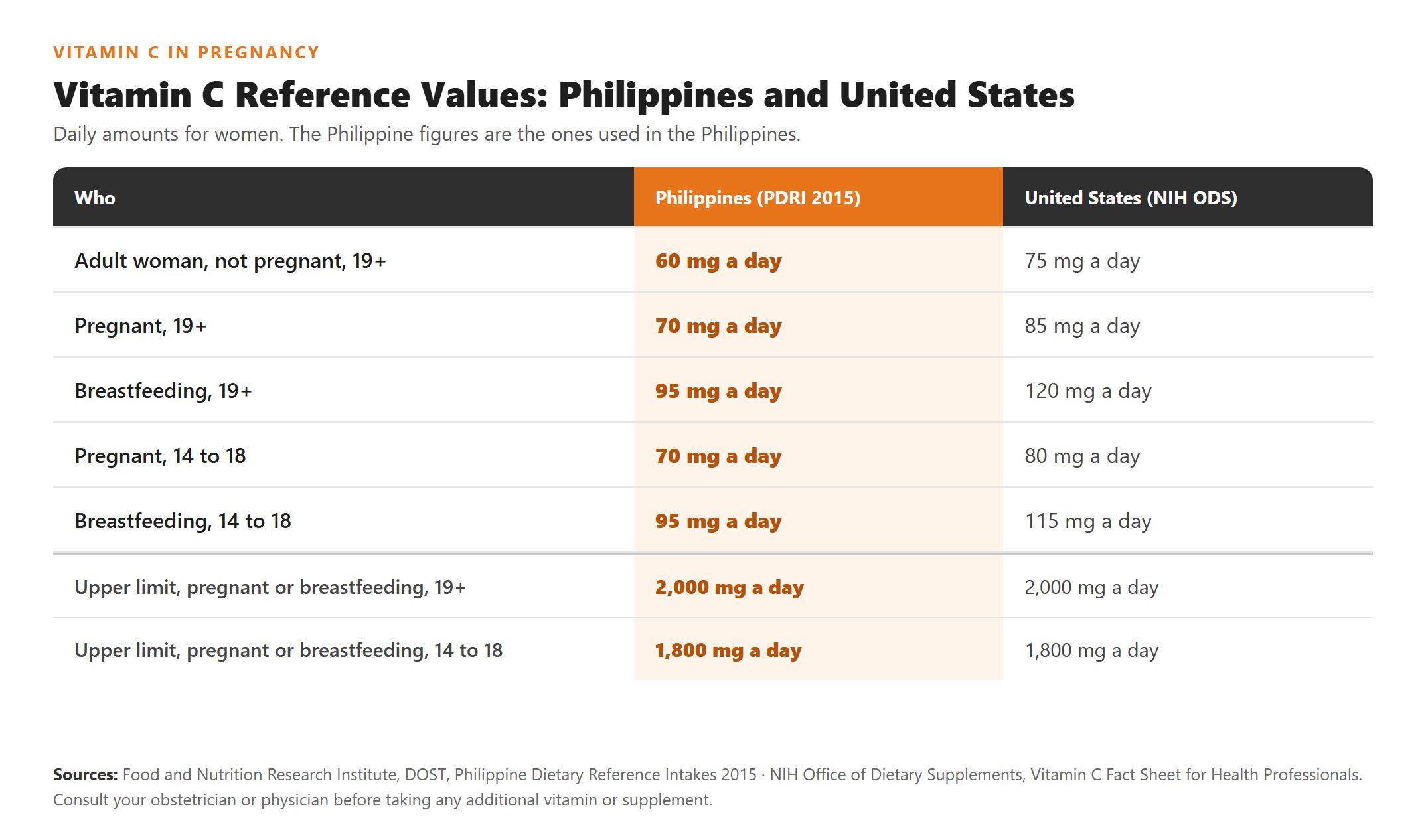
Both standards can be used side by side, and the comparison below sets them out together. The practical point is smaller than it looks: check which country a nutrition figure belongs to before you act on it.
Vitamin C Reference Values: Philippines and United States
Adult woman, not pregnant, 19+. Philippines (PDRI 2015): 60 mg a day. United States (NIH ODS): 75 mg a day.
Pregnant, 19+. Philippines (PDRI 2015): 70 mg a day. United States (NIH ODS): 85 mg a day.
Breastfeeding, 19+. Philippines (PDRI 2015): 95 mg a day. United States (NIH ODS): 120 mg a day.
Pregnant, 14 to 18. Philippines (PDRI 2015): 70 mg a day. United States (NIH ODS): 80 mg a day.
Breastfeeding, 14 to 18. Philippines (PDRI 2015): 95 mg a day. United States (NIH ODS): 115 mg a day.
Upper limit, pregnant or breastfeeding 19+. Philippines (PDRI 2015): 2,000 mg a day. United States (NIH ODS): 2,000 mg a day.
Upper limit, pregnant or breastfeeding 14 to 18. Philippines (PDRI 2015): 1,800 mg a day. United States (NIH ODS): 1,800 mg a day.
Is There an Upper Limit in Pregnancy?
Yes, and it is worth knowing where it sits and what it applies to.
The PDRI sets a Tolerable Upper Intake Level, the highest daily amount from all sources combined that is not expected to cause harm. For pregnant and breastfeeding women aged 19 and over it is 2,000 mg a day. For pregnant and breastfeeding girls aged 14 to 18 it is lower, at 1,800 mg a day. That second figure matters in a country where a meaningful share of pregnancies are in that age group.
An upper limit is a ceiling, not a target. The gap between the 70 mg requirement and the ceiling is not an invitation to fill it.
One distinction matters here, and it is the reason the last paragraph is worded carefully. The PDRI is the reference for dietary intake and for products registered as food supplements. A product registered as a drug is governed by its own registration and its own approved label instead, so the PDRI ceiling is not the figure that sets what such a product may contain. If you are taking vitamin C from more than one product, ask your obstetrician or pharmacist to total it for you rather than working it out from a table. How the Philippine upper limits apply to products is covered in how much vitamin C Filipino adults actually need per day.
Why Does Your Body Need Vitamin C During Pregnancy?
Your body cannot make its own vitamin C. The NIH Office of Dietary Supplements states that humans "are unable to synthesize vitamin C endogenously, so it is an essential dietary component." That is why the Philippine reference value rises in pregnancy, from 60 mg to 70 mg a day.
The NIH describes what vitamin C does in the body:
Collagen. Vitamin C helps the body make collagen. The NIH states that vitamin C "is required for the biosynthesis of collagen", and that collagen "is an essential component of connective tissue, which plays a vital role in wound healing."
Antioxidant. The NIH describes vitamin C as "an important physiological antioxidant."
Iron. Vitamin C helps the body absorb iron from plant foods. The NIH states that it "improves the absorption of nonheme iron, the form of iron that is present in plant-based foods." This matters in pregnancy, because iron is the supplement the Philippine programme gives pregnant women (see below).
Consult your obstetrician or physician before taking any additional vitamin or supplement, especially in combination with the supplements you already take.
What Does the Philippine Programme Actually Supply in Pregnancy?
Pregnant and breastfeeding women are a named priority group in the Philippine national micronutrient supplementation policy, set out in Department of Health Administrative Order No. 2010-0010.
The micronutrients that policy addresses are vitamin A, iron, iodine and zinc. If you have been to a public prenatal check-up in the Philippines, iron is the one you will have been handed. How and when you take iron in pregnancy is something your obstetrician is already managing, so raise vitamin C with them too.
What About Taking Vitamin C With Zinc While Pregnant?
Vitamin C and zinc are often sold together, so this question follows the last one closely. Zinc has its own Philippine reference value, its own ceiling, and one interaction that matters a great deal in pregnancy.
The PDRI sets zinc for an adult woman aged 19 to 49 at 4.6 mg a day. Pregnancy adds 5.1 mg, which brings it to 9.7 mg a day. Breastfeeding adds 7.0 mg, which brings it to 11.6 mg a day. The upper limit for pregnant and breastfeeding women aged 19 and over is 40 mg a day, and 34 mg for those aged 14 to 18. On zinc, unlike vitamin C, the Philippine and American ceilings are the same figures.
Consult your obstetrician or physician before adding zinc, especially in combination with the supplements you already take. What each nutrient does is covered in vitamin C and zinc.
Why Does Zinc Matter If You Are Already Taking Iron?
This is the practical part, and it is the reason a combination product is worth raising with your doctor rather than deciding at the counter.
The NIH Office of Dietary Supplements states that "taking supplements containing 25 mg elemental iron or more at the same time as zinc supplements can reduce zinc absorption and plasma zinc concentrations". Iron given during pregnancy comes as a supplement, and it is the micronutrient the Philippine programme actually hands out.
The same page notes that iron added to enriched or fortified foods does not interfere in the same way, because that form of iron is poorly soluble in the gut and does not compete strongly with zinc. So this is specifically about supplements taken together, not about food.
Put the three facts side by side and the picture is clear enough. Vitamin C improves the absorption of the iron in plant foods. Supplemental iron at 25 mg or more can work against zinc when the two are taken at the same time. Iron is what you are most likely to have been given. None of that is an argument for or against any product. It is an argument for your obstetrician or pharmacist deciding what you take and when you take it, because timing and totals are exactly what they are trained to work out.
So What Is the Best Vitamin C for a Pregnant Woman?
This is the question most people arrive with, and it does not have a product for an answer. It has three checks, and they apply to everything on the shelf.
Does the amount match what your doctor says you need? The Philippine requirement in pregnancy is 70 mg a day, and a great deal of what is sold contains several times that in a single unit. Whether that is appropriate for you is a clinical judgement, not a shelf one.
Do you know everything else you are taking? Prenatal vitamins already contain vitamin C, so anything additional is on top of a number you may not have been told.
Can you read the pack and check the registration? The generic name, what one unit contains, how many the pack asks for in a day, the registration number and the expiry date should all be findable in under a minute. If you cannot find them, ask the pharmacist before you buy. What to look for on a pack is covered in which vitamin C pharmacists recommend and what they check first.
Answer those three with your obstetrician and the brand question tends to answer itself.
What Should You Ask Your Obstetrician?
Bring the pack, or a photo of it, and work through these:
How much am I getting already? Between food and anything you were given at your check-up, you may be at or above 70 mg before you add anything.
What is in everything I am taking? List all of it, including anything bought without being told to.
How many milligrams are in one unit, and how many does the pack ask for in a day? Multiply the two before you compare anything to the figures above.
Does anything about my pregnancy change the answer? Existing conditions, kidney problems, and how your pregnancy has gone so far can all matter.
Should I take it at all? A doctor who says no is answering the question, not dismissing it.
Is Bewell-C Suitable During Pregnancy?
That is a question for your obstetrician, and we are not going to answer it for them. What we can do is tell you exactly what these products are, so you can bring accurate information to that conversation.
Bewell-C Non-Acidic Vitamin C contains ascorbic acid (as sodium ascorbate), the non-acidic form of vitamin C, in a capsule. Its label directions read: "Take 1-3 capsules a day with beverage or meal or as prescribed by physician." It is registered with the Philippine FDA as a non-prescription drug rather than as a food supplement, under registration number DRHR-1355, and the registration covers the treatment and prevention of vitamin C deficiency.
Bewell-C Zinc Protect is the same non-acidic vitamin C together with 10 mg of zinc, in a single capsule. Its label directions read: "Take 1-2 capsules a day with beverage or meal or as prescribed by physician." It is registered separately, as an over-the-counter drug, under registration number DRP-8652. If you are considering a combination product, the iron question in the section above is the one to raise first, and the zinc on the pack is what your doctor will want to add to whatever else you are taking.
Neither registration is a statement about pregnancy. No part of either one says the product is intended for use during pregnancy or while breastfeeding, and nothing on this page should be read as saying so. That distinction also explains why the PDRI ceiling discussed earlier is not the figure that governs these products: the PDRI sets limits for dietary intake and for food supplements, and both of these are registered as drugs.
If you are pregnant or breastfeeding, take the pack to your obstetrician or pharmacist and ask them. That is the same advice we would give about any product in this category, including our own.
How Much Vitamin C Do You Need While Breastfeeding?
The Philippine reference value rises more after birth than during pregnancy. The PDRI adds 35 mg for breastfeeding, which brings the daily figure to 95 mg, against the 70 mg that applies while pregnant. The United States figure for the same group is 120 mg.
The upper limit does not change: 2,000 mg a day for women aged 19 and over, and 1,800 mg for those aged 14 to 18, whether pregnant or breastfeeding.
The rest of the guidance on this page carries over. Food first, everything you are taking listed out loud, and the decision made with the person following your care rather than from a pack or a search result.
A Note on What This Page Is
This is general information about a nutrient, drawn from Philippine and international reference standards. It is not medical advice, it is not a recommendation to take or to avoid any product, and it cannot account for your individual pregnancy.
Talk to your obstetrician, your midwife or your pharmacist before starting, stopping or changing anything you take during pregnancy or while breastfeeding.
About Bewell Nutraceuticals Corporation
Bewell Nutraceuticals Corporation is a Philippine FDA-licensed Trader and Distributor of both Drug and Food, operating from Quezon City since 2007. Bewell manages the formulation and the sourcing of raw materials for its products, which are manufactured by a partner and sold through Mercury Drug, Watsons, South Star Drug, Rose Pharmacy and other drugstores nationwide. The company supplies Bewell-C, ascorbic acid (as 500 mg sodium ascorbate) per capsule, registered with the Philippine FDA as a non-prescription drug under registration number DRHR-1355, and labelled at one to three capsules daily. Bewell-C reaches Filipino buyers through Mercury Drug, Watsons, South Star Drug, Rose Pharmacy, Rojon, and small chain drugstores, plus official stores on Shopee, Lazada, and TikTok Shop. To see the full Bewell-C range and where to buy it, visit the Bewell-C product page.
Frequently Asked Questions
How much vitamin C does a pregnant woman need per day in the Philippines?
Seventy milligrams a day. The Philippine Dietary Reference Intakes 2015 set the value for an adult woman aged 19 to 49 at 60 mg and add 10 mg for pregnancy. While breastfeeding the addition is 35 mg, which brings the figure to 95 mg a day. These are the Philippine figures, set by the Food and Nutrition Research Institute of the Department of Science and Technology.
Why do some sources say 85 mg for pregnancy?
Because 85 mg is the United States figure, set by the NIH Office of Dietary Supplements for pregnant women aged 19 and over. The Philippine figure is 70 mg. Both are correct for their own population, and both standards can be used side by side. Most international articles, and most AI assistant answers, quote the American number even when the question names the Philippines, so check which country a nutrition figure belongs to before acting on it.
Can pregnant women take vitamin C in the Philippines?
Vitamin C is a normal part of prenatal nutrition and the Philippine Dietary Reference Intakes set a value for it in pregnancy, at 70 mg a day. Whether you should add anything on top of what you already get from food and from your prenatal check-up is a question for the doctor following your pregnancy, because it depends on your intake, everything else you are taking, and how your pregnancy is going.
What is the best vitamin C for pregnant women?
That question does not have a product for an answer. It has three checks: whether the amount matches what your doctor says you need, whether you know everything else you are taking, since prenatal vitamins already contain vitamin C, and whether you can read the pack and check its registration. The Philippine requirement in pregnancy is 70 mg a day, and much of what is sold contains several times that in one unit, so whether any given product suits you is a clinical judgement rather than a shelf one.
Is there a maximum amount of vitamin C in pregnancy?
The Philippine Dietary Reference Intakes set a Tolerable Upper Intake Level of 2,000 mg a day for pregnant and breastfeeding women aged 19 and over, and 1,800 mg a day for those aged 14 to 18. That is a ceiling from all sources combined rather than a target. The PDRI is the reference for dietary intake and for products registered as food supplements; a product registered as a drug is governed by its own registration and approved label instead.
Why do you need vitamin C during pregnancy?
Your body cannot make its own vitamin C, so it has to come from food or supplements. The NIH Office of Dietary Supplements states that vitamin C is required for making collagen, "an essential component of connective tissue", that it is "an important physiological antioxidant", and that it "improves the absorption of nonheme iron", the iron in plant foods. The Philippine reference value rises from 60 mg to 70 mg a day in pregnancy. Consult your obstetrician or physician before adding any vitamin or supplement.
Is ascorbic acid safe for pregnant women?
Ascorbic acid is vitamin C in its acid form, and sodium ascorbate is the sodium salt of the same vitamin, explained in sodium ascorbate vs ascorbic acid. Which form suits you, and whether to take either during pregnancy, is a question to put to your obstetrician or pharmacist along with everything else you are taking. Bring the pack so they can see what one unit contains and how many the pack asks for in a day.
Can pregnant women take vitamin C with zinc?
Zinc has its own Philippine reference value. The PDRI sets 9.7 mg a day in pregnancy and 11.6 mg while breastfeeding, with an upper limit of 40 mg a day at 19 and over and 34 mg at 14 to 18. One interaction is worth raising with your obstetrician: the NIH Office of Dietary Supplements states that supplements containing 25 mg elemental iron or more, taken at the same time as zinc, can reduce zinc absorption. Iron is what the Philippine programme gives in pregnancy.
Is Bewell-C suitable during pregnancy?
That is a question for your obstetrician. Bewell-C Non-Acidic Vitamin C contains ascorbic acid (as sodium ascorbate) in a capsule, its label says to take one to three capsules a day with a beverage or meal, and it is registered with the Philippine FDA as a non-prescription drug rather than as a food supplement, under registration number DRHR-1355, covering the treatment and prevention of vitamin C deficiency. Bewell-C Zinc Protect is the same non-acidic vitamin C with zinc in a single capsule, registered separately as an over-the-counter drug under DRP-8652. Neither registration is a statement about pregnancy, and nothing on this page should be read as saying either product is intended for use during pregnancy or while breastfeeding. Take the pack to your obstetrician or pharmacist and ask them.
How much vitamin C do you need while breastfeeding?
The Philippine Dietary Reference Intakes add 35 mg for breastfeeding on top of the 60 mg adult woman value, which gives 95 mg a day. The United States figure for the same group is 120 mg. The upper limit is unchanged from pregnancy, at 2,000 mg a day for women aged 19 and over and 1,800 mg for those aged 14 to 18.
What vitamins does the Philippine health system give pregnant women?
Pregnant and breastfeeding women are a named priority group in Department of Health Administrative Order No. 2010-0010, the national policy on micronutrient supplementation. The micronutrients that policy addresses are vitamin A, iron, iodine and zinc. Ask at your check-up what you have been given and what it contains before adding anything to it.
Related Bewell Products
Bewell-C Non-Acidic Vitamin C: Ascorbic acid (as sodium ascorbate), the non-acidic form, in a capsule. Label directions: "Take 1-3 capsules a day with beverage or meal or as prescribed by physician."
Bewell-C Zinc Protect: The same non-acidic vitamin C together with 10 mg of zinc, in a single capsule. Registered as an over-the-counter drug under DRP-8652.
Related Articles
Vitamin C 500mg or 1000mg: How Much Filipino Adults Actually Need Per Day
Which Vitamin C Do Pharmacists Recommend and What They Check First
Sources
Food and Nutrition Research Institute, Department of Science and Technology. Philippine Dietary Reference Intakes 2015: Summary Tables, Recommended Nutrient Intakes and Tolerable Upper Intake Levels
Office of Dietary Supplements, National Institutes of Health. Vitamin C: Fact Sheet for Health Professionals, Recommended Dietary Allowances, Tolerable Upper Intake Levels and Selected Food Sources
Office of Dietary Supplements, National Institutes of Health. Zinc: Fact Sheet for Health Professionals, Recommended Dietary Allowances, Tolerable Upper Intake Levels and interactions with iron supplements
Department of Health, Republic of the Philippines. Administrative Order No. 2010-0010, Revised Policy on Micronutrient Supplementation to Support Achievement of 2015 MDG Targets to Reduce Underfive and Maternal Deaths and Address Micronutrient Needs of Other Population Groups