 Blogs
Blogs 
 Sep 18, 2026
  9 mins read
Sodium ascorbate and ascorbic acid are both vitamin C. Ascorbic acid is the acid itself and its solution is acidic. Sodium ascorbate is its sodium salt and its solution is close to neutral, which is where the shelf term non-acidic comes from. The trade-off is that sodium ascorbate is about 11.6 percent sodium by weight. The NIH states that research has not shown any form of vitamin C to work better than the others, so acidity and sodium are what the choice actually turns on.
Sodium Ascorbate and Ascorbic Acid Are Both Vitamin C
The short answer is that both are the same vitamin in two chemical forms, and the international food standards treat them as a single family.
Ascorbic acid is vitamin C itself. The FAO and WHO Joint Expert Committee on Food Additives lists its chemical formula as C6H8O6 with a formula weight of 176.13 and gives "Vitamin C" as a direct synonym.
Sodium ascorbate is the sodium salt of that same acid. The matching JECFA specification gives its formula as C6H7O6Na with a formula weight of 198.11. One acidic hydrogen atom has been replaced by a sodium atom. Everything else about the molecule is unchanged.
The clearest sign that these are treated as one family is the safety assessment. Both specifications record that a group Acceptable Daily Intake of "not specified" was established for ascorbic acid together with its calcium, potassium and sodium salts at the 25th JECFA meeting in 1981. "Not specified" is the least restrictive category the committee uses. It applies to the acid and its salts as one group, not to each separately.
Both forms are vitamin C, so the useful question is what the sodium atom changes. There are exactly two answers worth knowing.
Difference One: Acidity, Which You Can Measure
This is the difference the Philippine market is built around, and it is real.
The JECFA specification for ascorbic acid sets a pH of 2.4 to 2.8 for a 1 in 50 solution. The specification for sodium ascorbate sets a pH of 6.5 to 8.0 for a 1 in 10 solution. Pure water sits at 7, so ascorbic acid in solution is firmly acidic while sodium ascorbate sits close to neutral.
One honest caveat, because it matters if you are checking the sources yourself. Those two figures are measured at different solution strengths, 1 in 50 for the acid and 1 in 10 for the salt, so they are not a like-for-like laboratory comparison. The direction is not in doubt, but the exact gap is not a single clean number.
That pH difference is the entire basis of the term "non-acidic vitamin C" that you see on Philippine shelves. It is a statement about the chemistry of the form, and it is accurate as far as it goes.
What it does not tell you is how any individual person will find a given product, because tolerance varies and a finished capsule contains more than the vitamin. If acidic vitamin C has caused you stomach discomfort in the past, the pH figures explain why a near-neutral form is the usual suggestion. Discuss it with a doctor or pharmacist rather than self-diagnosing from a pH table.
Difference Two: Sodium, Which Most Labels Do Not Spell Out
This is the side of the comparison that gets skipped, and it is the reason sodium ascorbate is not automatically the right pick for everyone.
If you replace a hydrogen atom with a sodium atom, you have added sodium. The arithmetic comes straight from the JECFA formula weights. Sodium has an atomic weight of about 22.99 and sodium ascorbate has a formula weight of 198.11, so sodium ascorbate is about 11.6 percent sodium by weight.
In practical terms:
500 mg of sodium ascorbate carries roughly 58 mg of sodium
1,000 mg carries roughly 116 mg
1,500 mg carries roughly 174 mg
Set that against the ceiling. The World Health Organization recommends less than 2,000 mg of sodium per day for adults, which it describes as equivalent to less than 5 g of salt, or just under a teaspoon. On those figures, 500 mg of sodium ascorbate uses about 3 percent of the daily sodium allowance, and 1,500 mg uses about 9 percent.
For a typical adult that is a small share. For someone who has been told by a doctor to restrict sodium, whether for blood pressure, kidney function, or another reason, it is a number worth raising with a professional. Ascorbic acid contributes no sodium at all, and for that reader it is the form that fits.
If you are managing sodium intake, bring the actual product label to your doctor or pharmacist and ask. That is a better use of five minutes than any article.
Does One Form Work Better Than the Other?
This is the question everyone actually wants answered, and the honest answer is that the research does not support a winner.
The National Institutes of Health Office of Dietary Supplements addresses it directly in its vitamin C fact sheet. After listing the forms found in supplements, including sodium ascorbate, calcium ascorbate, other mineral ascorbates, and ascorbic acid with bioflavonoids, it states:
"Research has not shown that any form of vitamin C is better than the other forms."
Source: National Institutes of Health, Office of Dietary Supplements, Vitamin C Consumer Fact Sheet.
The health professional version of the same fact sheet goes further into the evidence and reaches the same place. It notes that only a few human studies have compared the bioavailability of different forms and reports that one study found no differences in plasma vitamin C levels or in urinary excretion of vitamin C across three sources: ascorbic acid, a commercial calcium ascorbate product, and ascorbic acid with bioflavonoids.
Read those two statements together, and the picture is clear. Claims that one form is absorbed dramatically better than another are running ahead of the evidence, whichever form is being sold. The differences that survive scrutiny are the two in the sections above: how acidic the form is, and how much sodium it brings with it.
That is a more useful conclusion than a winner, because it means the choice is yours to make on your own circumstances rather than a question with one right answer.
How to Read a Philippine Vitamin C Label
Two labels can both say 500 mg and mean slightly different things. This is worth two minutes because it is where most confusion starts, and you can check it yourself in the pharmacy aisle.
Look at how the strength is expressed. You will see all three of these on Philippine packs:
"Sodium Ascorbate 500 mg". The figure refers to the weight of the salt.
"Ascorbic Acid (as Sodium Ascorbate) 500 mg". The figure refers to the vitamin C, and the salt it came from weighs somewhat more.
Both figures printed together, the vitamin C and the salt it came from. This is the clearest of the three, because nothing is left unstated.
None of the three wordings is wrong. The point is simply that the headline number is not always measuring the same thing, so read the full strength statement on the pack rather than the figure on the front, and ask a pharmacist if it is unclear.
The other check takes about a minute. Every health product legally sold here carries a Philippine FDA registration number, printed on the pack. A pack with no number, or a number that does not belong to the product named on it, is the thing worth walking away from. If you want to confirm a number, your pharmacist can look it up with you.
For the full seven-point checklist to use in the pharmacy aisle, see How to Choose the Best Vitamin C in the Philippines: A 2026 Buyer's Guide.
Which Form Suits You
Putting the two differences together, the decision is narrower than the marketing suggests.
Ascorbic acid is the form to look at if you tolerate it without stomach discomfort, and it is the form that fits if you are restricting sodium.
Sodium ascorbate is the form to look at if acidic vitamin C has given you stomach discomfort, since its solution sits close to neutral rather than in the acidic range. The trade-off is the sodium it contributes, which is minor for a typical adult and material for someone on a sodium-restricted diet.
Both deliver vitamin C, and on the evidence the NIH summarizes, neither has been shown to outperform the other. Whichever you choose, the daily amount to follow is the one printed on the label of the specific product you bought, because that figure was assessed for that product during registration.
For how much vitamin C Filipino adults actually need each day, see Vitamin C 500mg or 1000mg: How Much Filipino Adults Actually Need Per Day.
Two things sit outside what any article can settle for you. If you are pregnant or breastfeeding, if you are managing a health condition such as hypertension or kidney disease, or if you take regular medicines, ask a doctor or pharmacist which form and which amount suits your situation. And remember that vitamin C is present in everyday Filipino food, so a supplement is there to supplement a diet rather than to replace what you eat.
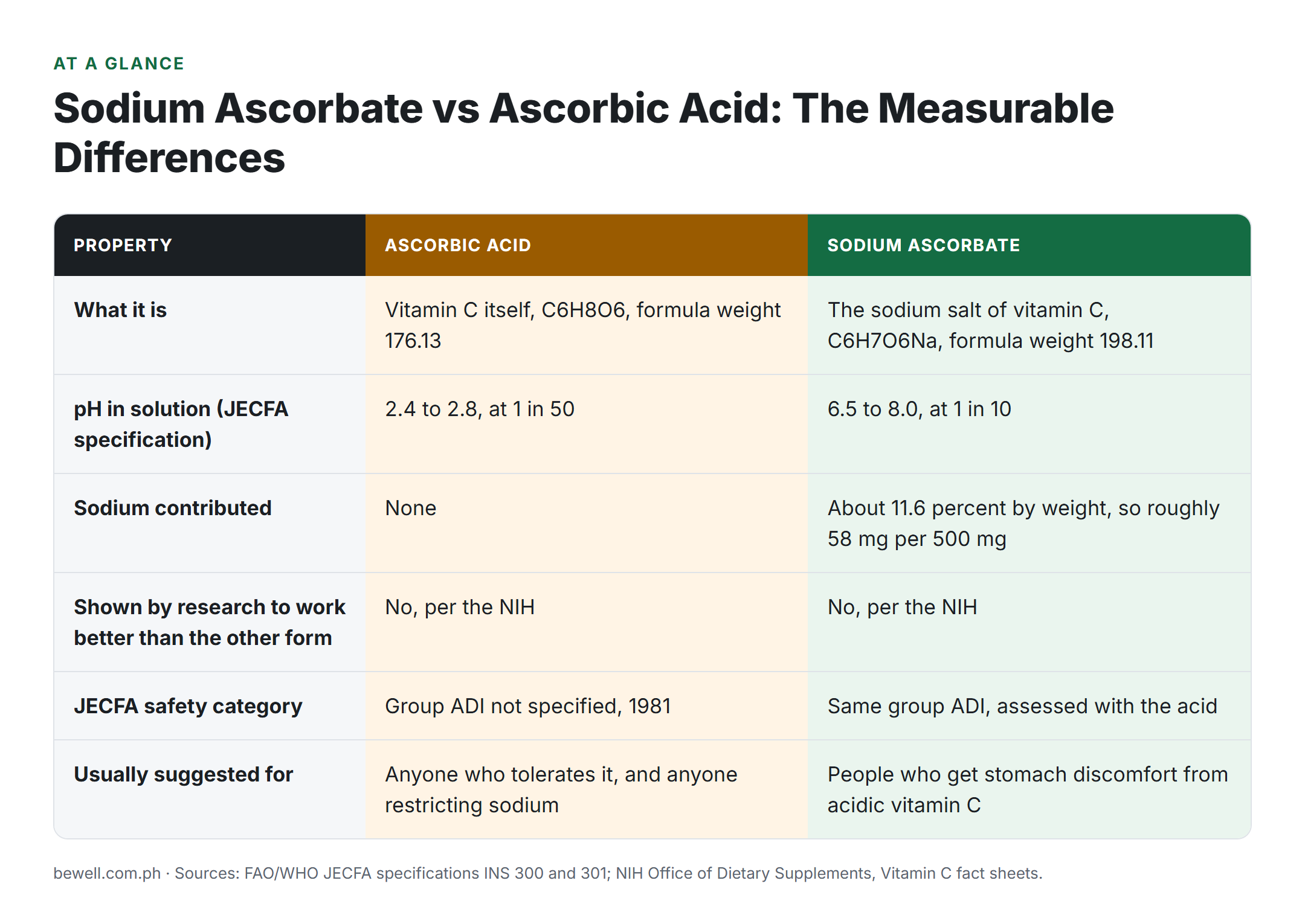
Sodium Ascorbate and Ascorbic Acid on the Measurable Differences
What it is
Ascorbic acid: vitamin C itself, C6H8O6, formula weight 176.13.
Sodium ascorbate: the sodium salt of vitamin C, C6H7O6Na, formula weight 198.11.
pH in solution (JECFA specification)
Ascorbic acid: 2.4 to 2.8, at 1 in 50.
Sodium ascorbate: 6.5 to 8.0, at 1 in 10.
Sodium contributed
Ascorbic acid: none.
Sodium ascorbate: about 11.6 percent by weight, so roughly 58 mg per 500 mg.
Shown by research to work better than the other form
Ascorbic acid: no, per the NIH.
Sodium ascorbate: no, per the NIH.
JECFA safety category
Ascorbic acid: group ADI not specified, 1981.
Sodium ascorbate: same group ADI, assessed with the acid.
Usually suggested for
Ascorbic acid: anyone who tolerates it, and anyone restricting sodium.
Sodium ascorbate: people who get stomach discomfort from acidic vitamin C.
Where Bewell-C Sits
For readers who came here from a product page, the plain facts.
Bewell-C is a sodium ascorbate vitamin C at 500 mg per capsule, registered with the Philippine FDA as a non-prescription drug under registration number DRHR-1355, and labelled at one to three capsules daily.
That places it on the sodium ascorbate side of this article, with everything above applying to it exactly as written, including the sodium arithmetic. The registration number is printed on the pack.
The range also includes Bewell-C Zinc Protect, which pairs non-acidic vitamin C with zinc, and Bewell-C Kids, a syrup formulated for children. How vitamin C and zinc work as a pair is covered in Vitamin C and Zinc: What the Combination Actually Does. Follow the label on the specific product you buy, and speak to a doctor or pharmacist about what fits your circumstances.
Medical Disclaimer
This article is general information about the chemistry of vitamin C forms. It is not medical advice, and it is not a substitute for a consultation with a qualified professional.
Speak to a doctor or a licensed pharmacist before starting any vitamin C product, and particularly if you are pregnant or breastfeeding, are managing hypertension, kidney disease or any other condition, are on a sodium-restricted diet, or are taking prescription medicines. Always follow the daily amount printed on the label of the product you purchased.
About Bewell Nutraceuticals Corporation
Bewell Nutraceuticals Corporation is a Philippine FDA-licensed Trader and Distributor of both Drug and Food, operating from Quezon City since 2007. Bewell manages the formulation and the sourcing of raw materials for its products, which are manufactured by a partner and sold through Mercury Drug, Watsons, South Star Drug, Rose Pharmacy and other drugstores nationwide. The company supplies Bewell-C, a sodium ascorbate vitamin C at 500 mg per capsule, registered with the Philippine FDA as a non-prescription drug under registration number DRHR-1355, and labelled at one to three capsules daily. Bewell-C reaches Filipino buyers through Mercury Drug, Watsons, South Star Drug, Rose Pharmacy, Rojon, and small chain drugstores, plus official stores on Shopee, Lazada, and TikTok Shop. To see the full Bewell-C range and where to buy it, visit bewell.com.ph.
Frequently Asked Questions
What is the difference between sodium ascorbate and ascorbic acid?
They are the same vitamin in two chemical forms. Ascorbic acid is vitamin C itself, formula C6H8O6. Sodium ascorbate is its sodium salt, formula C6H7O6Na, where one acidic hydrogen has been replaced by sodium. The two practical differences are acidity and sodium content. The JECFA specifications put ascorbic acid at pH 2.4 to 2.8 in a 1 in 50 solution and sodium ascorbate at pH 6.5 to 8.0 in a 1 in 10 solution, and sodium ascorbate is about 11.6 percent sodium by weight while ascorbic acid contains none.
Which is better, sodium ascorbate or ascorbic acid?
Neither has been shown to outperform the other. The NIH Office of Dietary Supplements states that research has not shown that any form of vitamin C is better than the other forms, and its health professional fact sheet reports a study that found no differences in plasma vitamin C or urinary excretion across three different vitamin C sources. Choose on acidity and sodium rather than on strength, and ask a doctor or pharmacist what suits your situation.
Is sodium ascorbate really non-acidic?
Its solution is close to neutral rather than acidic. The FAO and WHO Joint Expert Committee on Food Additives specifies a pH of 6.5 to 8.0 for a 1 in 10 solution of sodium ascorbate, against 2.4 to 2.8 for a 1 in 50 solution of ascorbic acid. Pure water sits at pH 7. That is where the shelf term non-acidic vitamin C comes from. Note that the two specification figures are measured at different solution strengths, so they show the direction of the difference rather than an exact laboratory gap.
How much sodium is in sodium ascorbate?
About 11.6 percent by weight, calculated from the JECFA formula weight of 198.11 and the atomic weight of sodium. That works out to roughly 58 mg of sodium in 500 mg of sodium ascorbate, roughly 116 mg in 1,000 mg, and roughly 174 mg in 1,500 mg. The World Health Organization recommends less than 2,000 mg of sodium a day for adults, so 500 mg of sodium ascorbate uses about 3 percent of that. If you have been advised to restrict sodium, discuss the specific product with your doctor or pharmacist.
Who should avoid sodium ascorbate?
This is a question for your doctor or pharmacist rather than an article, because it depends on your own circumstances. The relevant fact is that sodium ascorbate contributes sodium and ascorbic acid does not, so anyone who has been advised to restrict sodium intake, for blood pressure, kidney function or any other reason, should raise the specific product with a professional before taking it. Bring the pack so they can read the label.
How do I know a vitamin C product is properly registered in the Philippines?
Every health product legally sold in the Philippines carries a registration number issued by the Philippine FDA, and it must be printed on the pack. If a pack carries no registration number at all, or the number does not belong to the product named on it, treat that as a reason not to buy. Your pharmacist can confirm a number for you.
Related Bewell Products
Bewell-C Non-Acidic Vitamin C. Sodium ascorbate at 500 mg per capsule.
Bewell-C Zinc Protect. Non-acidic vitamin C paired with zinc in a single capsule.
Bewell-C Kids. Non-acidic vitamin C with zinc, in a syrup formulated for children.
Related Reading
How to Choose the Best Vitamin C in the Philippines: A 2026 Buyer's Guide
Vitamin C 500mg or 1000mg: How Much Filipino Adults Actually Need Per Day
Sources
National Institutes of Health, Office of Dietary Supplements. Vitamin C, Consumer Fact Sheet
National Institutes of Health, Office of Dietary Supplements. Vitamin C, Health Professional Fact Sheet
FAO and WHO Joint Expert Committee on Food Additives. Sodium Ascorbate, JECFA Monograph specification, INS No. 301
FAO and WHO Joint Expert Committee on Food Additives. Ascorbic Acid, JECFA Monograph specification, INS No. 300
World Health Organization. Sodium reduction, fact sheet
DOST Food and Nutrition Research Institute. Philippine Dietary Reference Intakes 2015, Summary Tables
Journal of the American Dietetic Association, via PubMed. Johnston CS, Luo B. Comparison of the absorption and excretion of three commercially available sources of vitamin C. J Am Diet Assoc. 1994;94(7):779-81