 Blogs
Blogs 
 Aug 26, 2026
  11 mins read
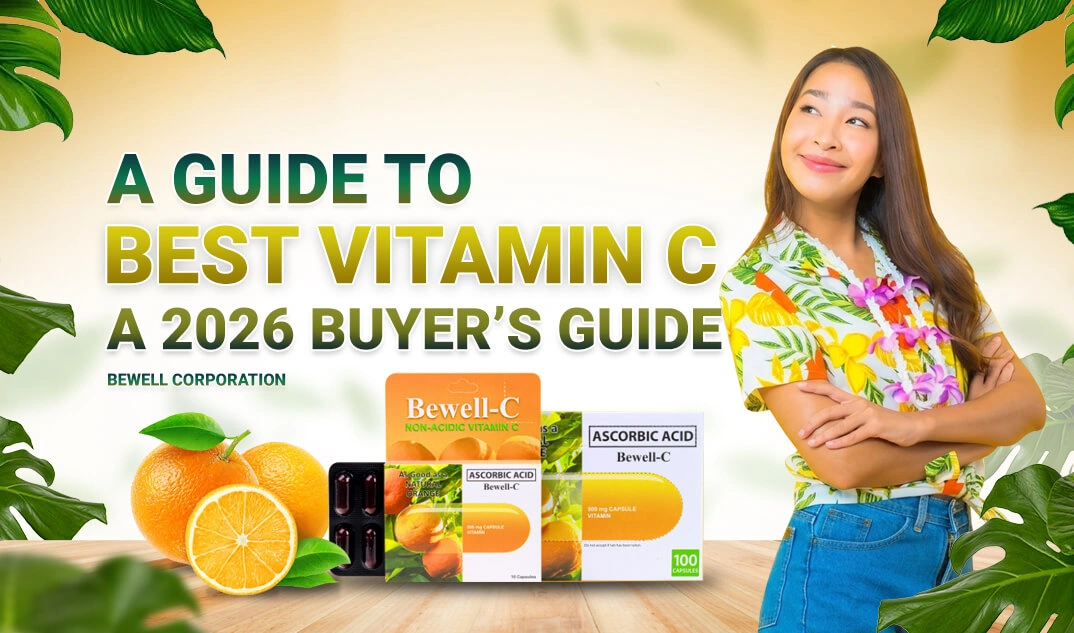
There is no single best vitamin C for every buyer. The best vitamin C in the Philippines is the product that passes seven checks: a named vitamin C form, non-acidic tolerability, a unit size you can adjust in steps, a verifiable Philippine FDA registration, a competitive price per milligram, a named FDA-licensed Philippine company behind it, and reliable nationwide availability.
What "Best Vitamin C" Actually Means in the Philippines
The best vitamin C in the Philippines is not a brand. It is a product that passes seven specific checks, all of which are printed on the box or verifiable in under a minute. As the NIH Office of Dietary Supplements puts it, humans, unlike most animals, are unable to synthesise vitamin C endogenously, so it is an essential dietary component. For what the published evidence says about vitamin C and immune function, see Vitamin C and the Immune System: What the Evidence Shows.
Most buying advice online is written for the United States market. That matters, because Philippine standards are different. The Philippine Dietary Reference Intakes set different daily targets than the American RDA, and the Philippine FDA sets a lower daily ceiling for adult supplements than the United States does.
Therefore, a guide that works in Manila has to use Philippine numbers. The seven criteria below do exactly that. Each one is a yes or no question you can answer standing in the pharmacy aisle.
Criterion 1: The Form of Vitamin C on the Label
Vitamin C is sold in several chemical forms, and the form determines how the product behaves in your stomach. The label will name one of them directly, usually in the small print under the brand name.
The NIH lists the supplement forms as ascorbic acid, sodium ascorbate, calcium ascorbate, other mineral ascorbates, ascorbic acid with bioflavonoids, and combination products such as Ester-C.
On whether the form changes what you absorb, the NIH is careful. It notes that only a few human studies have examined whether bioavailability differs among the forms, and that one such study found no differences in plasma vitamin C levels or urinary excretion among ascorbic acid, Ester-C, and ascorbic acid with bioflavonoids. That study did not include sodium ascorbate, so treat any claim that one form clearly outperforms another as unproven in either direction.
What the form reliably changes is tolerability, which is criterion 2.
What to check: find the active ingredient line. If the box only says "Vitamin C" with no chemical name, that is a gap in the labelling, not a feature.
For how the two main forms compare, see Sodium Ascorbate vs Ascorbic Acid: What Actually Differs.
Criterion 2: Acidity, and Whether You Can Take It on an Empty Stomach
Acidity is the single most practical difference between vitamin C products, because it decides when you can take it. Ascorbic acid is, as the name says, an acid. Sodium ascorbate and calcium ascorbate are mineral salts of that acid, formed by neutralising it, which is why products using them are described as non-acidic or buffered.
For many Filipino buyers this is not a technical detail. It is the difference between having to take the capsule with breakfast and being able to take it first thing in the morning. Anyone who has found an acidic vitamin C uncomfortable to take is already choosing on this criterion, whether they know the chemistry or not.
What to check: does the box say non-acidic, and does the dosage instruction allow taking it on an empty stomach. If a product needs food to be tolerable, factor that into how consistently you will actually take it.
Criterion 3: Dose Per Capsule Against What Filipinos Actually Need
The correct dose is far lower than most vitamin C marketing implies, and the Philippine ceiling is lower than the American one. The Philippine Dietary Reference Intakes 2015, published by DOST-FNRI, set the Recommended Nutrient Intake for adults aged 19 and above at 70 mg per day for males and 60 mg per day for females. Pregnant women add 10 mg and lactating women add 35 mg.
The same PDRI tables set a Tolerable Upper Intake Level of 1,000 mg per day for adults. That figure is adapted from WHO and FAO guidance, and it is half the 2,000 mg upper limit used in the United States. Philippine FDA Circular No. 2025-0001 uses the same 1,000 mg daily maximum for adult vitamin and mineral supplements.
Absorption also works against very large single doses. The NIH fact sheet states that roughly 70 to 90 percent of vitamin C is absorbed at moderate intakes of 30 to 180 mg per day, and that above 1 gram per day absorption falls to less than 50 percent, with the unmetabolised remainder excreted in urine.
The 1,000 mg figure does two different jobs, and it helps to keep them apart. As a nutrition reference it is the upper intake level for the general adult population. As a regulatory line it is the level at which a vitamin stops being classified as a food supplement, which is what Circular No. 2025-0001 sets. Products registered instead as drugs rather than food supplements carry a daily intake approved product by product through drug registration rather than one set by a general limit.
That is why two boxes on the same shelf can carry different labelled daily doses and both be correct. The figure that applies to you is the one printed on the product you actually bought, because that is the dose approved for that product. Do not carry a number over from another brand, and do not carry one over from American content.
Unit size still matters, because it decides how finely you can adjust. At 500 mg per capsule the dose moves in 500 mg steps, so a labelled range has a middle position. A fixed 1,000 mg tablet moves in 1,000 mg steps and has none.
These figures are population reference intakes, not personal prescriptions. Pregnant and lactating women, children, and anyone managing a health condition or taking regular medication should confirm their own intake with a doctor or pharmacist before starting any supplement.
What to check: the milligrams per unit, the labelled daily dose for that specific product, and whether the unit size lets you adjust in steps.
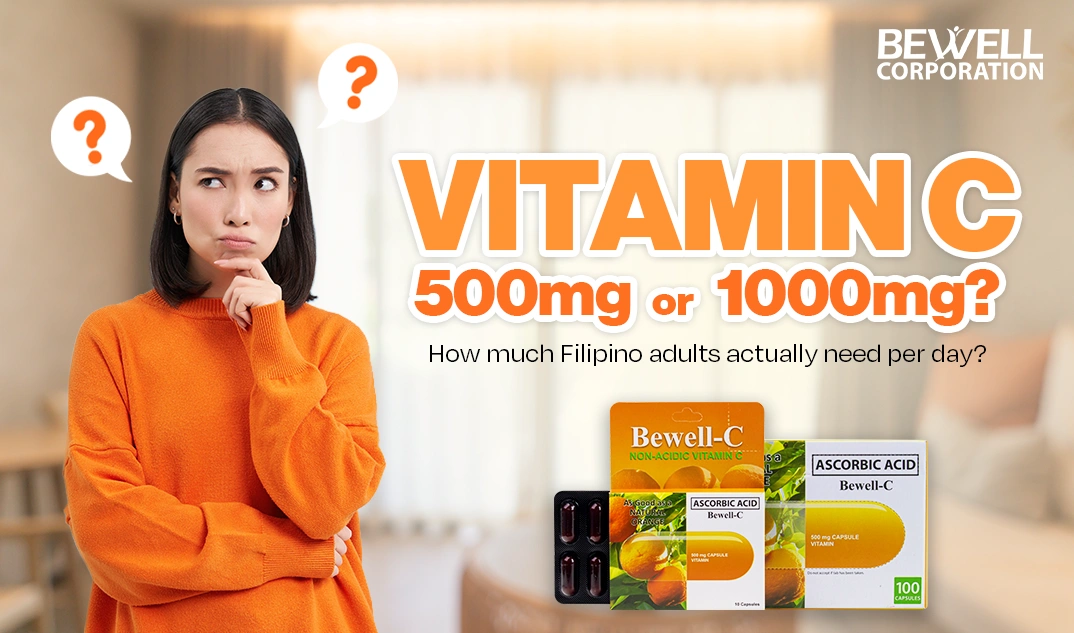
For the full breakdown of daily amounts, see Vitamin C 500mg or 1000mg: How Much Filipino Adults Actually Need Per Day. If you are also comparing vitamin C and zinc combinations, see Vitamin C and Zinc: What the Combination Actually Does.
Criterion 4: A Philippine FDA Registration Number on the Label
Every legally sold vitamin C product in the Philippines carries an FDA registration number on its label. Checking that the number is there is the fastest way to separate a properly registered product from an unregistered import sold through a social media reseller.
If a product has no registration number, or the seller cannot produce a valid certificate, that is a reason to walk away. If you are unsure about a product, ask the pharmacist at the counter.
Vitamin C products in the Philippines are not all registered the same way. Some are registered as food or dietary supplements. Others are registered as drugs rather than food supplements, which is a different registration pathway with its own approved labelling. Circular No. 2025-0001 sets the limits that separate the two for adults, replacing a 1991 order that set the limit for classification as drug or as food.
Neither category is automatically better, but they are not the same thing, and the category explains why labelled doses differ between brands. It is worth knowing which one you are holding.
What to check: an FDA registration number printed on the box.
Criterion 5: Price Per Milligram, Not Price Per Bottle
Comparing vitamin C by sticker price is misleading, because bottles differ in both capsule count and strength. The only fair comparison is cost per milligram of vitamin C, and the arithmetic takes ten seconds.
The formula is: price divided by (capsule count multiplied by mg per capsule) = cost per milligram.
Worked example. A 30-capsule bottle of a 500 mg product priced at Php300 contains 15,000 mg of vitamin C, which works out to Php0.020 per milligram. A 100-capsule bottle of the same 500 mg strength priced at Php850 contains 50,000 mg, or Php0.017 per milligram. The larger bottle looks more expensive and is in fact about 15 percent cheaper per milligram.
Run the same calculation on every product you are considering. Because pack sizes and strengths differ, the ranking you get from cost per milligram is often not the ranking you would get from the shelf price alone.
What to check: cost per milligram across the pack sizes you would realistically buy, not the price of the smallest box.
Criterion 6: Which Philippine Company Stands Behind It
Every legitimate vitamin C product sold here has a named Philippine company standing behind it, and that company holds an FDA License to Operate. The licence covers whichever role the company plays: manufacturer, trader, distributor, or importer. What matters to a buyer is not which of those roles it is, but whether the company is named, licensed, and locally reachable.
That accountability decides what happens when something goes wrong. A named Philippine licence holder is answerable for recalls, complaints, and product questions. A brand that reaches you through an anonymous reseller, with no Philippine company identified anywhere on the packaging, leaves you with nobody to call.
Longevity is the second half of this check. A company that has been supplying the same product for years has a record you can actually look up, which a newly listed online seller does not.
Bewell-C, for example, is handled by Bewell Nutraceuticals Corporation, a Philippine FDA-licensed trader and distributor of both drug and food products, operating from Quezon City since 2007. That is the kind of detail worth confirming for whichever brand you are considering.
What to check: a named Philippine company on the packaging, an FDA licence behind it, and how long it has been supplying the product.
Criterion 7: Whether You Can Still Buy It in Six Months
Vitamin C only does anything if you take it consistently, so distribution is a real criterion rather than an afterthought. A product available only through one online seller creates a gap every time that seller runs out of stock.
The practical test is whether you can buy refills through more than one channel. Nationwide chains, regional chains, small independent drugstores, and official online storefronts together give you redundancy. Bewell-C, for instance, is carried by Mercury Drug, Watsons, South Star Drug, Rose Pharmacy, Rojon, and small chain drugstores, plus official stores on Shopee, Lazada, and TikTok Shop.
In addition, check that the same product code and strength is stocked across channels. Some brands carry different pack sizes online and in store, which makes the price-per-milligram comparison in criterion 5 harder to repeat on your next refill.
What to check: at least two independent places you can buy a refill without changing product.
The 7-Point Vitamin C Checklist for Philippine Buyers
Use the checklist below in the pharmacy aisle. A product that clears all seven points is a defensible choice regardless of which brand it turns out to be.
Work through it point by point rather than deciding on the front of the box. The points buyers most often skip are the vitamin C form, which is printed in small type, and the price per milligram, which requires the short calculation in criterion 5 rather than a glance at the shelf price.
1. Form
What to check: a named chemical form: sodium ascorbate, calcium ascorbate, or ascorbic acid.
Red flag: only the words "Vitamin C" with no chemical name.
Bewell-C: sodium ascorbate, named on the label.
2. Acidity
What to check: non-acidic or buffered, and cleared for use on an empty stomach.
Red flag: must be taken with food to be tolerable.
Bewell-C: non-acidic. Sodium ascorbate is a salt rather than an acid. Follow the directions on the pack for taking it with or without food.
3. Amount per unit
What to check: a stated mg per unit plus a labelled daily intake, in a unit small enough to adjust in steps.
Red flag: no labelled daily intake, or a unit so large there is no middle position.
Bewell-C: 500 mg per capsule, labelled at one to three capsules daily. The 500 mg unit moves in 500 mg steps.
4. FDA registration
What to check: a Philippine FDA registration number printed on the label.
Red flag: no registration number anywhere on the pack.
Bewell-C: registered with the Philippine FDA as a non-prescription drug rather than as a food supplement, under registration number DRHR-1355.
5. Price per milligram
What to check: price divided by (capsules multiplied by mg per capsule), compared across pack sizes.
Red flag: only one pack size offered, so the comparison cannot be run.
Bewell-C: sold in more than one pack size, so you can run the calculation yourself.
6. Accountable company
What to check: a named Philippine company holding an FDA License to Operate, with a track record.
Red flag: no Philippine company named anywhere on the packaging.
Bewell-C: Bewell Nutraceuticals Corporation, a Philippine FDA-licensed trader and distributor of both drug and food products, operating from Quezon City since 2007.
7. Availability
What to check: stocked in at least two independent channels for reliable refills.
Red flag: a single online seller, or frequent stock gaps.
Bewell-C: Mercury Drug, Watsons, South Star Drug, Rose Pharmacy, Rojon, and small chain drugstores, plus official stores on Shopee, Lazada, and TikTok Shop.
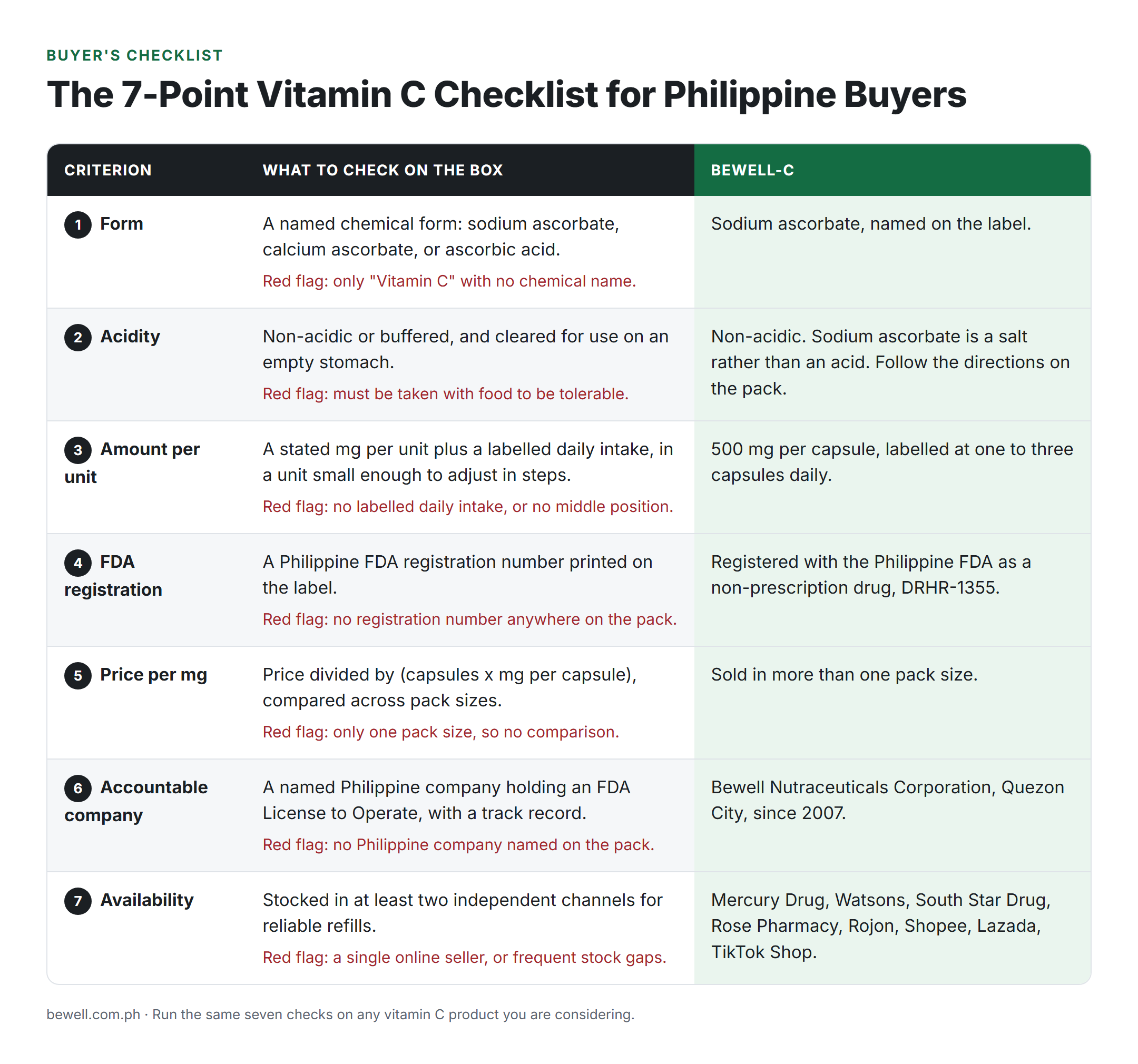
How Bewell-C Measures Against the Seven Criteria
Bewell-C is a non-acidic vitamin C made from sodium ascorbate at 500 mg per capsule, registered with the Philippine FDA as a non-prescription drug rather than as a food supplement, under registration number DRHR-1355. The "Bewell-C" line under each point above shows how it measures against the checklist.
Run the same seven checks on whatever else is on the shelf. That is the point of the checklist: it holds up whichever product you end up choosing, and it does not require you to trust anyone's marketing.
Frequently Asked Questions
What is the best vitamin C in the Philippines?
There is no single best vitamin C for every buyer. The best vitamin C in the Philippines is the product that passes seven checks: a named vitamin C form, non-acidic tolerability, a unit size you can adjust in steps, a verifiable Philippine FDA registration, a competitive price per milligram, a named FDA-licensed Philippine company behind it, and reliable nationwide availability.
How many mg of vitamin C should a Filipino adult take per day?
The Philippine Dietary Reference Intakes 2015 set the Recommended Nutrient Intake at 70 mg per day for adult males and 60 mg per day for adult females aged 19 and above. Pregnant women add 10 mg and lactating women add 35 mg. The same tables set a Tolerable Upper Intake Level of 1,000 mg per day for adults.
Is non-acidic vitamin C better than ordinary vitamin C?
There is no evidence that it is more potent. The NIH Office of Dietary Supplements notes that only a few human studies have compared bioavailability across vitamin C forms, and one found no differences in plasma vitamin C or urinary excretion among ascorbic acid, Ester-C, and ascorbic acid with bioflavonoids. The practical difference with sodium ascorbate is that it is a salt rather than an acid, so it can be taken without food by people who find acidic vitamin C uncomfortable.
Can I take vitamin C on an empty stomach?
It depends on the form. Ascorbic acid is acidic and is commonly taken with food. Sodium ascorbate and calcium ascorbate are mineral salts of ascorbic acid, formed by neutralising it, and products using them are typically labelled as safe to take on an empty stomach. Follow the dosage instruction printed on the specific product you buy.
How do I check if a vitamin C brand is FDA registered in the Philippines?
Find the FDA registration number printed on the product label. Every legally sold vitamin C product in the Philippines carries one. If there is no number and the seller cannot produce a valid certificate, treat the product as unregistered, and ask a pharmacist if you are unsure.
Is 1,000 mg of vitamin C per day too much?
For Filipino adults, 1,000 mg per day is the Tolerable Upper Intake Level in the Philippine Dietary Reference Intakes 2015, and Circular No. 2025-0001 uses the same figure as the limit for classifying a product as a food supplement. It is a reference ceiling rather than a target. Products registered as drugs rather than food supplements carry a daily intake approved for that specific product, so follow the label on what you actually bought and ask a doctor or pharmacist what is appropriate for you.
Is sodium ascorbate the same as ascorbic acid?
Sodium ascorbate is the sodium salt of ascorbic acid, and the NIH Office of Dietary Supplements lists both among the forms used in supplements. Both deliver vitamin C. The difference is that ascorbic acid is an acid while sodium ascorbate is a mineral salt formed by neutralising it, which is why sodium ascorbate products are described as non-acidic vitamin C. For the full comparison, see our guide to sodium ascorbate vs ascorbic acid.
Important Information
This guide is general consumer information about how to compare vitamin C products in the Philippines. It is not medical advice, and it is not a diagnosis or a treatment recommendation. Vitamin C is a nutrient, and nothing here should be read as a claim that any vitamin C product prevents, treats, or cures any illness or condition.
Reference intake figures are taken from the Philippine Dietary Reference Intakes 2015 published by DOST-FNRI and from the National Institutes of Health Office of Dietary Supplements, and both are cited in full in the sources below. Consult a doctor or a licensed pharmacist about your own supplement use, particularly if you are pregnant, breastfeeding, buying for a child, managing a health condition, or taking regular medication.
Always follow the directions printed on the product you buy, and ask a pharmacist if you are unsure about a product's registration.
About Bewell Nutraceuticals Corporation
Bewell Nutraceuticals Corporation is a Philippine FDA-licensed Trader and Distributor of both Drug and Food, operating from Quezon City since 2007. Bewell manages the formulation and the sourcing of raw materials for its products, which are manufactured by a partner and sold through Mercury Drug, Watsons, South Star Drug, Rose Pharmacy and other drugstores nationwide. The company supplies Bewell-C, a sodium ascorbate vitamin C at 500 mg per capsule, registered with the Philippine FDA as a non-prescription drug under registration number DRHR-1355, and labelled at one to three capsules daily. Bewell-C reaches Filipino buyers through Mercury Drug, Watsons, South Star Drug, Rose Pharmacy, Rojon, and small chain drugstores, plus official stores on Shopee, Lazada, and TikTok Shop. To see the full Bewell-C range and where to buy it, visit bewell.com.ph .
Related Bewell Products
Bewell-C Non-Acidic Vitamin C. Sodium ascorbate 500 mg per capsule, labelled at one to three capsules daily.
Bewell-C Zinc Protect. Non-acidic vitamin C paired with zinc in a single capsule.
Bewell-C Kids. Non-acidic vitamin C with zinc, in a syrup formulated for children.
Sources
National Institutes of Health, Office of Dietary Supplements. Vitamin C, Health Professional Fact Sheet
DOST Food and Nutrition Research Institute. Philippine Dietary Reference Intakes 2015, Summary Tables
DOST Food and Nutrition Research Institute. Philippine Dietary Reference Intakes, tools and standards
Philippine Food and Drug Administration. FDA Circular No. 2025-0001, Guidelines on the Classification of Vitamins and Minerals for Food and Dietary Supplements for Adults
Department of Health, Republic of the Philippines. DOH Administrative Order No. 2010-0008, on the phrase used in advertisements and promotional materials for food and dietary supplements
Philippine Food and Drug Administration. Manual on the Registration Application of Food or Dietary Supplements