 Blogs
Blogs 
 Sep 7, 2026
  12 mins read
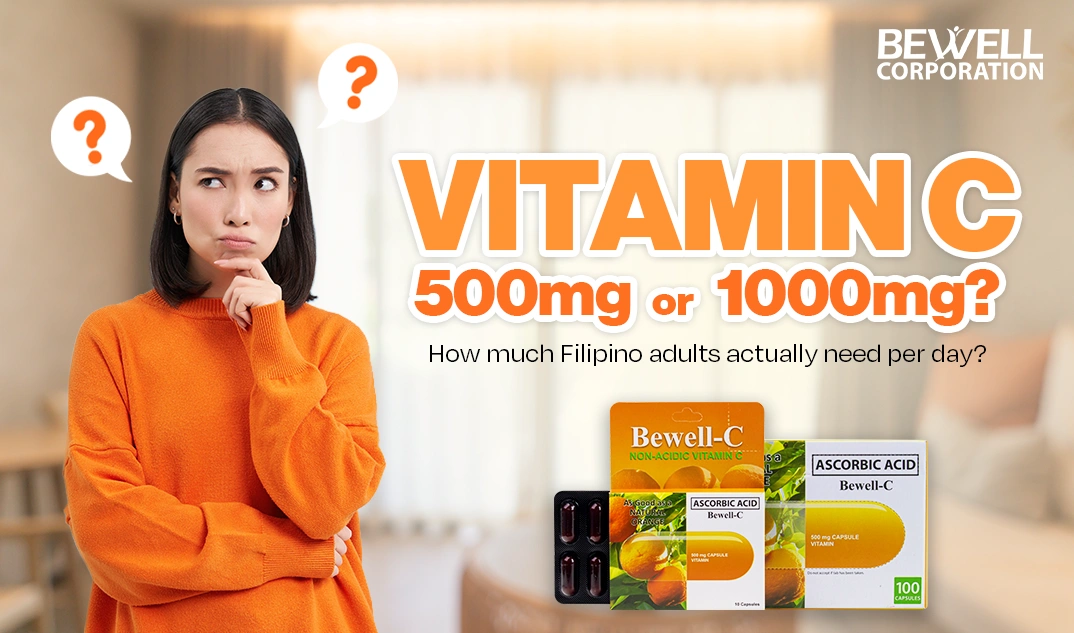
The Philippine Dietary Reference Intakes 2015, published by DOST-FNRI, set the Recommended Nutrient Intake for adults aged 19 and above at 70 mg per day for males and 60 mg per day for females. A single 500 mg capsule already provides several times the daily requirement. The figure that governs what you take is the one printed on the product in your hand.
How Much Vitamin C Filipino Adults Actually Need Per Day
The daily requirement is much lower than the numbers printed on most vitamin C boxes. The Philippine Dietary Reference Intakes 2015, published by DOST-FNRI, set the Recommended Nutrient Intake for adults aged 19 and above at 70 mg per day for males and 60 mg per day for females.
That is the amount that meets the needs of most Filipino adults. It is not a minimum to survive and it is not a target to beat. It is the reference figure the Philippine standard is built on.
Two things follow from that. Firstly, a single 500 mg capsule already provides several times the daily requirement. Secondly, the question worth asking is not whether 500 mg is enough, because it plainly is. The real question is where the upper figures come from, and that is where Philippine and American references part company.
Why a 500mg Capsule Sits So Far Above the Daily Requirement
If the requirement is 70 mg, a 500 mg capsule looks like a strange size. Two facts about how the body handles vitamin C explain why capsule strengths sit above the reference figure rather than at it, and they also explain why the numbers stop mattering higher up.
The first is that intake from food varies and is easily lost. The NIH Office of Dietary Supplements states that the vitamin C content of food may be reduced by prolonged storage and by cooking, because ascorbic acid is water-soluble and is destroyed by heat. A reference intake describes an average requirement, while what actually reaches you from a cooked meal is lower than the figure listed for the raw ingredient.
The second is that the body reaches a plateau. The NIH states that at daily intakes of 100 mg or higher, cells appear to be saturated, and at intakes of at least 200 mg, plasma concentrations increase only marginally. Total body content of vitamin C ranges from about 300 mg at near-scurvy levels to roughly 2g.
Read together, those two facts set both a floor and a ceiling on what is useful. An amount comfortably above the reference intake covers dietary variation and absorption losses. An amount far above it does not keep adding in proportion, because the cells are already saturated and plasma barely moves. A 500 mg unit sits in that useful band. Where the upper figures come from is the subject of the next section.
The 1,000mg Figure, and the Two Different Jobs It Does
The number most often quoted as the Philippine vitamin C limit is 1,000 mg per day. It is worth understanding, because it does two separate jobs and people routinely collapse them into one.
As a nutrition reference, the PDRI 2015 tables set a Tolerable Upper Intake Level of 1,000 mg per day for Filipino adults, derived from WHO and FAO guidance. The United States National Institutes of Health sets its equivalent at 2,000 mg, double the Philippine figure, and the Harvard T.H. Chan School of Public Health states the same 2,000 mg figure, noting that going beyond it may promote gastrointestinal distress and diarrhoea. Neither number is wrong. They are set by different bodies using different frameworks, and both are cited in Philippine practice: the 1,000 mg PDRI figure is the local nutrition reference, while the 2,000 mg figure is the widely used international safety ceiling.
As a regulatory line, the same figure appears in Philippine FDA Circular No. 2025-0001, where it marks the level at which a vitamin stops being classified as a food or dietary supplement for adults.
That second job is the one buyers miss. Vitamin C products above that line are not banned. They are registered differently, as drugs rather than as food supplements, and the daily amount on their label is approved product by product through drug registration rather than set by a general limit. For ascorbic acid in drug products the applicable limit is 2,000 mg per day, the same figure the NIH and Harvard use.
So two boxes on the same shelf can carry different labelled daily amounts and both be correct. An upper intake level is a reference ceiling for the population, not a target and not a hard wall on every product. The figure that governs what you take is the one printed on the product in your hand.
What Happens to Vitamin C Above 1,000mg Per Day
Very large single amounts deliver less than the label suggests, because absorption efficiency falls as the amount rises.
The NIH fact sheet states that roughly 70 to 90 percent of vitamin C is absorbed at moderate intakes of 30 to 180 mg per day. It also states that above 1 gram per day, absorption falls to less than 50 percent, and the absorbed but unmetabolised remainder is excreted in urine.
In plain terms, the body has a saturation point. Past it, a rising share of what you swallow is passed rather than used. A 2,000 mg amount does not deliver twice what a 1,000 mg amount delivers, and the gap between label and delivered amount widens as the number on the box goes up.
An important caveat belongs here, because reference intakes describe ordinary conditions. Vitamin C requirements increase while the body is fighting an infection, and in conditions associated with oxidative and inflammatory stress. Carr and Maggini, writing in Nutrients, report that infections significantly affect vitamin C levels because of enhanced inflammation and metabolic demand, and that decreases in leukocyte vitamin C have been measured during common cold episodes. In other words, illness can substantially lower your vitamin C level. What is appropriate for you in those circumstances is a question for a doctor or pharmacist, working from the label of the product you have. What the trials show about vitamin C and colds is covered in Vitamin C and the Immune System: What the Evidence Shows.
Why Unit Size Matters More Than the Number on the Front
Two products can reach the same daily total and still behave differently, because what decides your control is the size of a single unit.
At 500 mg per capsule, the daily amount moves in 500 mg steps. A product labelled at one to three capsules a day therefore has three positions rather than one: you can sit at the bottom, the middle, or the top of its range, and move between them as your diet, your schedule, or your doctor's advice changes.
A fixed 1,000 mg tablet moves in 1,000 mg steps and has no middle position. Halving a tablet is unreliable, and a capsule cannot be halved at all. If you want to step down on a given day, the format does not allow it.
Splitting can also help with absorption. Because efficiency is higher at moderate single amounts than at very large ones, spreading a daily intake across two times uses more of what you take than delivering all of it at once. Smaller units make that possible where the product's own instruction allows it; one large tablet does not.
The larger unit has its own advantage, and it is convenience. A single 1,000 mg tablet delivers the whole daily amount in one go. If your first opportunity to take it falls in the afternoon, one tablet is more practical than a 500 mg unit followed by a second one twelve hours later. Fewer units to remember is a real benefit for anyone who struggles to keep a twice-daily routine.
So neither format wins outright. A larger unit trades control for convenience, and a smaller unit trades convenience for control. Which matters more depends on whether your daily amount is fixed or varies, and on what the label of the product in your hand actually states.
Does It Matter What Time of Day You Take Vitamin C
Ascorbic acid is acidic, and is commonly taken with food for that reason. Sodium ascorbate and calcium ascorbate are mineral salts of that acid, formed by neutralising it, and products using them are typically labelled as safe to take on an empty stomach. That difference is what determines whether taking it before breakfast is comfortable or not.
Beyond that, a routine you can actually keep beats a theoretically optimal schedule you abandon after three weeks. Pick the time you will remember. If you are taking two capsules, spacing them out is a reasonable default, for the absorption reason above.
For how the forms differ, see Sodium Ascorbate vs Ascorbic Acid: What Actually Differs. For the full buying checklist, see How to Choose the Best Vitamin C in the Philippines: A 2026 Buyer's Guide. For zinc in combination products, see Vitamin C and Zinc: What the Combination Actually Does.
Vitamin C Reference Intakes by Life Stage in the Philippines
The reference intakes change with age, pregnancy, and breastfeeding. The figures below are from the PDRI 2015 tables.
Adult males, 19 and above. 70 mg per day.
Adult females, 19 and above. 60 mg per day.
Pregnant women. Add 10 mg, for 70 mg per day.
Lactating women. Add 35 mg, for 95 mg per day.
The upper intake level is not the same for everyone either. The PDRI 2015 tables set it at 1,000 mg per day for adults generally, but at 2,000 mg per day for pregnant and lactating women aged 19 and above. The difference comes from the sources the tables draw on: the general adult figure follows WHO and FAO guidance, while the pregnancy and lactation figure follows the United States Institute of Medicine. Children have their own lower reference intakes and their own lower ceilings, which is why paediatric vitamin C is sold at different strengths rather than as a smaller number of adult capsules.
A higher ceiling is not a reason to take more. The reference intake during pregnancy rises by only 10 mg, to 70 mg per day, and the ceiling is simply the point beyond which adverse effects become a concern.
These are population reference figures, not personal prescriptions. Pregnant and breastfeeding women, parents buying for children, older adults, and anyone managing a health condition or taking regular medication should confirm their own intake with a doctor or pharmacist rather than work from a table.
How to Read the Daily Amount on a Philippine Vitamin C Label
Three numbers on the box decide what you are actually buying, and they are not always presented in the same order.
Milligrams per capsule or tablet. The strength of a single unit. This is the number usually printed largest.
Labelled daily intake. How many units per day the product is labelled for. A 500 mg product labelled at one to three capsules daily has a range of 500 to 1,500 mg. A 1,000 mg product labelled at one tablet daily has a single position.
Units per pack. How long the pack lasts at your intended daily amount, which is also what makes a cost per milligram comparison possible.
Multiply the strength by the labelled daily intake to get your daily total, then read it against the reference figures above. Also note which category the product is registered under, because that is what determines the daily amount its label was approved to carry. If anything on the label is unclear, a pharmacist can tell you in a minute.
Finally, check that the product's registration number is printed on the pack before you pay. If you are unsure about a product, ask the pharmacist at the counter.
Vitamin C Daily Amount Options Compared
The comparison below sets the common formats against the Philippine standards. It is about formats, not brands.
Read it against your own situation rather than looking for the highest number. The option that fits most Filipino adults is the first one.
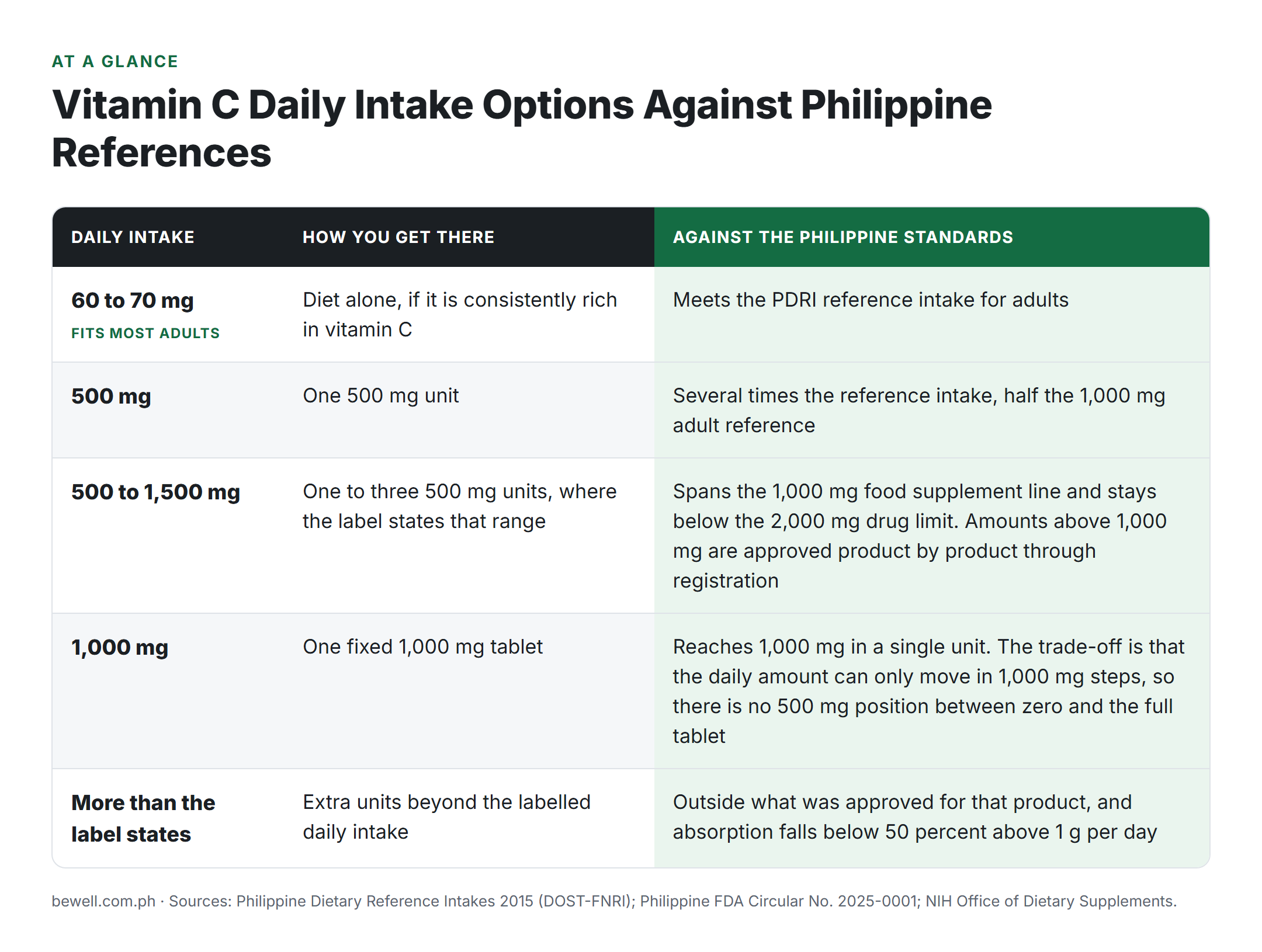
Vitamin C Daily Intake Options Against Philippine References
60 to 70 mg
How you get there: diet alone, if it is consistently rich in vitamin C.
Against the Philippine standards: meets the PDRI reference intake for adults.
500 mg
How you get there: one 500 mg unit.
Against the Philippine standards: several times the reference intake, half the 1,000 mg adult reference.
500 to 1,500 mg
How you get there: one to three 500 mg units, where the label states that range.
Against the Philippine standards: spans the 1,000 mg food supplement line and stays below the 2,000 mg drug limit. Amounts above 1,000 mg are approved product by product through registration.
1,000 mg
How you get there: one fixed 1,000 mg tablet.
Against the Philippine standards: reaches 1,000 mg in a single unit. The trade-off is that the daily amount can only move in 1,000 mg steps, so there is no 500 mg position between zero and the full tablet.
More than the label states
How you get there: extra units beyond the labelled daily intake.
Against the Philippine standards: outside what was approved for that product, and absorption falls below 50 percent above 1 g per day.
How Bewell-C Fits the Philippine Reference Figures
Bewell-C is a non-acidic vitamin C made from sodium ascorbate, labelled at one to three capsules daily. Each capsule contains 500 mg of sodium ascorbate, which is 444.5 mg of ascorbic acid, because part of the weight of the salt is the sodium it is bound to. It is registered with the Philippine FDA as a non-prescription drug rather than as a food supplement, under registration number DRHR-1355, and it is indicated for the treatment and prevention of vitamin C deficiency. Against the references set out above, that means the following.
Registration. DRHR-1355, a Philippine FDA non-prescription drug registration rather than a food supplement one.
Labelled daily intake. One to three capsules daily. In ascorbic acid that is 444.5 mg at the bottom of the range and about 1,334 mg at the top. That range was approved for this specific product through its registration.
Where the range sits. One capsule delivers 444.5 mg of ascorbic acid, several times the 70 mg and 60 mg reference intakes. Two capsules is 889 mg. Three is about 1,334 mg, below the 2,000 mg limit that applies to ascorbic acid in drug products.
Step size. The range moves one capsule at a time, so there are three positions to choose between rather than one fixed figure.
Form. Sodium ascorbate, a salt rather than an acid, which is what non-acidic refers to on the pack.
Following the label. Timing, and whether the daily amount may be split, are set by the instruction printed on the product. Read that rather than a general rule.
Bewell Nutraceuticals Corporation has supplied Bewell-C from Quezon City since 2007 as a Philippine FDA-licensed trader and distributor of both drug and food products. Whichever product you choose, run the same check: strength multiplied by the labelled daily intake, read against the reference figures, with the registration category noted.
Important Information
This guide is general consumer information about vitamin C reference intakes and capsule formats in the Philippines. It is not medical advice, and it is not a diagnosis or a personal treatment recommendation. Where an indication is stated for a specific registered product, it is the indication approved for that product by the Philippine FDA, and it applies to that product alone rather than to vitamin C in general.
All intake figures are taken from the Philippine Dietary Reference Intakes 2015 published by DOST-FNRI and from the National Institutes of Health Office of Dietary Supplements, both cited in the sources below. Consult a doctor or a licensed pharmacist about your own daily intake, particularly if you are pregnant, breastfeeding, buying for a child, managing a health condition, or taking regular medication.
Always follow the instructions printed on the product you buy, and ask a pharmacist if you are unsure about a product's registration.
About Bewell Nutraceuticals Corporation
Bewell Nutraceuticals Corporation is a Philippine FDA-licensed Trader and Distributor of both Drug and Food, operating from Quezon City since 2007. Bewell manages the formulation and the sourcing of raw materials for its products, which are manufactured by a partner and sold through Mercury Drug, Watsons, South Star Drug, Rose Pharmacy and other drugstores nationwide. The company supplies Bewell-C, a sodium ascorbate vitamin C at 500 mg of the salt per capsule, equal to 444.5 mg of ascorbic acid, registered with the Philippine FDA as a non-prescription drug under registration number DRHR-1355, indicated for the treatment and prevention of vitamin C deficiency, and labelled at one to three capsules daily. Bewell-C reaches Filipino buyers through Mercury Drug, Watsons, South Star Drug, Rose Pharmacy, Rojon, and small chain drugstores, plus official stores on Shopee, Lazada, and TikTok Shop. To see the full Bewell-C range and where to buy it, visit bewell.com.ph.
Frequently Asked Questions
How much vitamin C should I take per day in the Philippines?
The Philippine Dietary Reference Intakes 2015 set the Recommended Nutrient Intake at 70 mg per day for adult males and 60 mg per day for adult females aged 19 and above. Pregnant women add 10 mg and lactating women add 35 mg. The Tolerable Upper Intake Level is 1,000 mg per day for adults taking a food supplement, and 2,000 mg for pregnant and lactating women aged 19 and above. For ascorbic acid in drug products the limit is 2,000 mg per day. Ask a doctor or pharmacist what is appropriate for you.
Is 500mg of vitamin C enough?
For most Filipino adults, 500 mg per day is several times the reference intake of 70 mg for men and 60 mg for women. It also sits at half the 1,000 mg Philippine upper intake level, which leaves room to take a second capsule without exceeding the ceiling.
Is 1,000mg of vitamin C safe to take daily?
Yes. For Filipino adults, 1,000 mg per day is the Tolerable Upper Intake Level for food supplements in the Philippine Dietary Reference Intakes 2015, and Philippine FDA Circular No. 2025-0001 uses the same figure as the point where a product stops being classified as a food supplement. Above that line a vitamin C product is registered as a drug, where the limit for ascorbic acid is 2,000 mg per day. The United States National Institutes of Health and the Harvard T.H. Chan School of Public Health both put their upper intake level at the same 2,000 mg. Follow your product label and consult a doctor or pharmacist.
Can I take two 500mg vitamin C capsules a day?
Two 500 mg capsules total 1,000 mg, which is the Philippine Tolerable Upper Intake Level for food supplements in adults, and does not exceed the 2,000 mg limit that applies to drug products. Products labelled at one to three capsules daily are designed for a 500 to 1,500 mg range. Follow the label printed on the specific product you buy, and confirm with a doctor or pharmacist if you are pregnant, breastfeeding, or managing a health condition.
How much vitamin C is too much?
The Philippine Dietary Reference Intakes 2015 set the Tolerable Upper Intake Level at 1,000 mg per day for adults. The United States National Institutes of Health and the Harvard T.H. Chan School of Public Health put theirs at 2,000 mg, and Harvard notes that going beyond it may promote gastrointestinal distress and diarrhoea. You cannot get too much from food alone, but high-strength pills can cause unwanted side effects. Whatever the general figure, the operative number for you is the labelled daily intake of the product you bought, because that figure was approved for that product.
Does non-acidic vitamin C have a different daily intake?
No. The reference intakes and the 2,000 mg upper limit apply the same way regardless of form. The NIH Office of Dietary Supplements notes that only a few human studies have compared bioavailability across vitamin C forms, and one found no differences in plasma vitamin C or urinary excretion among ascorbic acid, Ester-C, and ascorbic acid with bioflavonoids. What changes with a non-acidic form is tolerability, including whether it can be taken on an empty stomach.
Related Bewell Products
Bewell-C Non-Acidic Vitamin C. Sodium ascorbate 500 mg per capsule, labelled at one to three capsules daily.
Bewell-C Zinc Protect. Non-acidic vitamin C paired with zinc in a single capsule.
Bewell-C Kids. Non-acidic vitamin C with zinc, in a syrup formulated for children.
Related Reading
Sources
DOST Food and Nutrition Research Institute. Philippine Dietary Reference Intakes 2015, Summary Tables
National Institutes of Health, Office of Dietary Supplements. Vitamin C, Health Professional Fact Sheet
Harvard T.H. Chan School of Public Health. The Nutrition Source, Vitamin C
Philippine Food and Drug Administration. FDA Circular No. 2025-0001, Guidelines on the Classification of Vitamins and Minerals for Food and Dietary Supplements for Adults
Carr AC, Maggini S. Vitamin C and Immune Function. Nutrients, 2017, volume 9, issue 11, article 1211